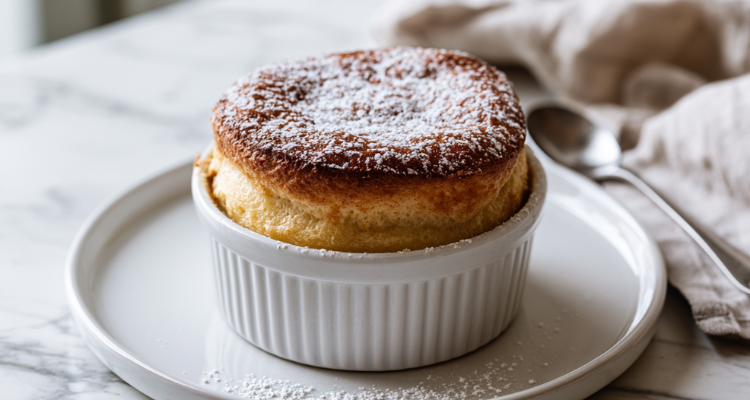

Gordon Ramsay’s vanilla soufflé is a baked French dessert built on a crème pâtissière base infused with a whole vanilla pod, folded with a glossy meringue and baked in individual ramekins. It serves 4 and takes about 50 minutes total.
This recipe draws from Gordon Ramsay’s Just Desserts, where his Rhubarb and Vanilla Soufflé uses a whole vanilla pod simmered directly into the fruit to extract maximum flavour from the seeds and skin together. The rhubarb is stripped back here to let the vanilla lead, using the same crème pâtissière base and ramekin method he applies across the soufflé chapter.
What makes his base different from most vanilla soufflé recipes is the double cream in the crème pâtissière. Most home recipes use only milk, which gives a thinner, less stable base. His mix of milk and double cream produces something closer to choux paste in thickness, and that density is what holds the meringue up during baking.
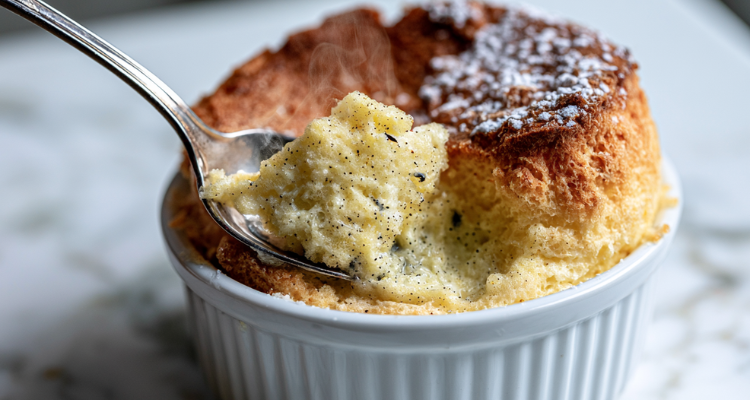
Gordon Ramsay Vanilla Souffle Recipe
Course: DessertsCuisine: BritishDifficulty: Easy4
20
minutes30
290
kcalA vanilla soufflé adapted from the Rhubarb and Vanilla Soufflé in Gordon Ramsay’s Just Desserts, with the rhubarb removed and vanilla intensity increased through a longer pod infusion. Ramekins are coated in two layers of butter then ground almonds or hazelnuts, which adds a faint nuttiness to the crust.
Ingredients
- Crème Pâtissière Base
5 fl oz (150ml) whole milk
3.5 fl oz (100ml) double cream (heavy cream)
1 vanilla pod, split and seeds scraped
1.5 oz (40g) caster sugar, divided
0.5 oz (15g) plain flour (all-purpose flour)
0.35 oz (10g) cornstarch (cornflour)
3 large free-range egg yolks
- Soufflé
2 large free-range egg whites
1.75 oz (50g) caster sugar
- To Coat the Ramekins
1.4 oz (40g) unsalted butter, melted
4 to 5 tablespoons ground almonds or hazelnuts, or grated dark chocolate
- To Finish
Icing sugar (powdered sugar), to dust
Directions
- Make the base: Heat the milk, double cream, vanilla pod and seeds, and 1 tablespoon of the sugar in a heavy-based saucepan until it just starts to scald. Remove the vanilla pod. Meanwhile sift the flour and cornstarch together. Beat the egg yolks and remaining sugar in a large bowl, then beat in the flour a third at a time. Slowly pour on a third of the hot creamy milk, whisking well to keep the mixture smooth, then whisk everything back into the pan. Simmer gently, whisking continuously, for 3 to 4 minutes until smooth and very thick. Transfer to a bowl, cover and cool, stirring occasionally to stop a skin forming.
- Prepare the ramekins: Brush four 150ml (5 fl oz) ramekins with a thin layer of melted butter using upward vertical strokes. Chill for 30 seconds to set. Brush on a second thin layer, then add ground almonds or hazelnuts and roll the ramekins so the coating covers the sides evenly. Tap out any excess. Refrigerate until needed. Preheat the oven to 375F (190C / Gas 5).
- Make the meringue: Whisk the egg whites in a large, completely clean bowl until they form firm peaks. Gradually whisk in the caster sugar a spoonful at a time until you have a glossy, stiff meringue.
- Combine and fill: Whisk a third of the meringue into the crème pâtissière base until fully smooth, then carefully fold in the rest with a large metal spoon in two parts, keeping as much air as possible. Divide immediately between the prepared ramekins and level the tops with a palette knife or the back of a spoon. Run your thumb around the inside rim to create a clean channel. Stand on a baking tray.
- Bake and serve: Bake for 12 to 15 minutes until well risen and golden on top. Do not open the oven door until the soufflés are almost ready. Dust quickly with icing sugar and serve immediately.
FAQs
Why does the crème pâtissière use double cream instead of just milk?
Double cream makes the base significantly thicker, close to the consistency of choux paste according to Ramsay’s own description in Just Desserts. That thickness is what gives the base enough structure to support the meringue during baking without the whole thing deflating under the weight. A milk-only base is thinner and less stable, which is why many home soufflés sink before they reach the table.
Why split and scrape the vanilla pod rather than using extract?
Scraping the pod gives you the seeds, which carry most of the vanilla’s flavour compounds, but simmering the whole split pod in the milk and cream extracts the oils from the skin too. Extract gives you one dimension. The pod gives you two, and because this recipe strips out the rhubarb entirely, the vanilla needs to carry the full flavour load on its own.
Why coat the ramekins twice instead of once?
Two thin coats of butter applied after chilling grip better than a single thick one, which can pool and leave gaps. Ramsay uses this double-varnish approach across his soufflé recipes because even coverage up the sides is what allows the batter to climb straight up during baking. The ground almonds or hazelnuts add a second layer of texture to the crust that you don’t get with sugar alone.
Why fold the meringue in two stages rather than all at once?
Folding in a third first loosens the crème pâtissière base until it’s close to the meringue’s consistency, which makes the remaining two thirds much easier to fold without deflating. Adding all the meringue at once to a thick, cold base forces you to work harder and longer, and overworking is what knocks the air out. Less movement means more volume in the oven.
What happens if you open the oven door too early?
The sudden drop in temperature causes the proteins in the egg whites to contract before they’ve set, and the soufflé collapses inward. Ramsay flags this directly in Just Desserts: don’t open the door until the soufflés are almost ready. If your oven runs hot or cold, use the window light to check rather than cracking the door. For another baked dessert where timing is everything, his molten lava cake has a similarly unforgiving bake window.
Can the base be made ahead and how far in advance?
Yes, up to one day ahead works well. Cover the surface of the crème pâtissière directly with plastic wrap while it’s still warm to stop a skin forming, then refrigerate. Before using, bring it back to room temperature and give it a good whisk to loosen it back to a smooth consistency. Cold base folded with meringue creates uneven pockets and an inconsistent rise. For another Ramsay soufflé built on the same crème pâtissière method, his strawberry soufflé uses the identical prep-ahead approach.

Zaytouna Studio Team is the kitchen team behind Chef Ramsay Recipes. We cook Gordon Ramsay’s recipes from his cookbooks and videos in a home kitchen and write them up for yours, with US and metric measurements.