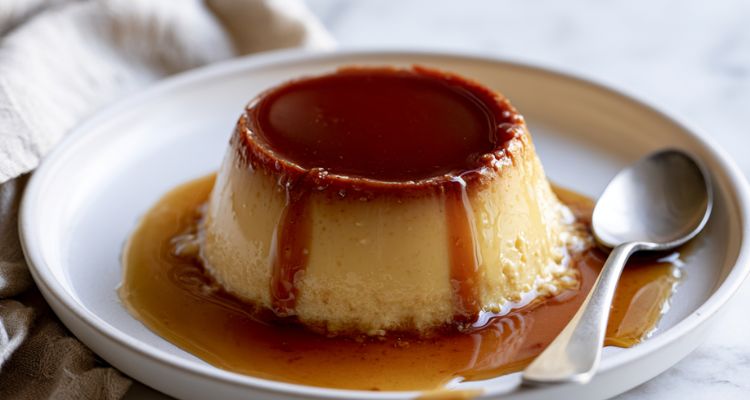
Gordon Ramsay’s flan recipe is a lavender crème caramel from Gordon Ramsay’s Ultimate Home Cooking, made with whole milk, eggs, vanilla seeds, and a caramel poured directly into the ramekins. It serves 4 and takes about 45 minutes active work, plus at least 4 hours in the fridge before you flip it.
The recipe is titled Lavender Crème Caramel in the book, where Ramsay writes: “A properly made crème caramel, rich with vanilla seeds and dripping with caramel, is an all-time classic. I’ve mainly stuck with tradition here, but the hint of lavender gives it another dimension.” The lavender comes from infused sugar, not fresh flowers in the custard.
The detail that separates his version: he only whisks eggs and sugar together at the last minute. Let them sit together before the milk goes in and the yolks start to break down, turning the custard grainy before it even hits the oven. Mix them right before you need them.
Gordon Ramsay Flan Recipe
Course: DessertsCuisine: BritishDifficulty: Easy4
15
minutes35
280
kcalCrème caramel under a Spanish name, built the way Ramsay does it in Ultimate Home Cooking. Six ingredients, lavender sugar in the custard, overnight chill for the caramel and custard to fully combine. The lavender is subtle enough that people who don’t expect it won’t identify it, but will notice something is different.
Ingredients
- Caramel
3/4 cup (150g) golden caster sugar
1 tsp lavender flowers, plus a few extra for decoration
Butter, for greasing the ramekins
- Custard
2 cups (500ml) whole milk
4 large free-range eggs
Seeds from 1 vanilla pod
1/4 cup (50g) lavender sugar (see Notes)
Directions
- Make the caramel: Preheat the oven to 300F (150C). Put the 3/4 cup sugar into a small heavy-based pan over medium-low heat and let it dissolve completely without stirring. Turn the heat up and boil until it turns dark golden caramel, about 2-3 minutes. Pour immediately into 4 ramekins (about 2/3 cup / 150ml each), dividing equally. Sprinkle each with a couple of lavender flowers and set aside to cool at room temperature, not in the fridge. Once set, grease the inside of each ramekin with a thin layer of butter.
- Scald the milk: Place the milk in a saucepan and warm gently over low heat until just below scalding point. Remove from heat the moment you see steam rising.
- Make the custard: Put the eggs, vanilla seeds, and lavender sugar into a bowl and whisk thoroughly. Do this right before the milk is ready, not in advance. Gradually pour the hot milk into the egg mixture, whisking as you go, until completely smooth. Transfer to a jug for easier pouring.
- Bake in a bain-marie: Place the ramekins in a roasting tin lined with a folded dish towel (this stops them sliding). Fill each with custard, dividing equally. Pour boiling water into the roasting tin until it comes halfway up the sides of the ramekins, taking care not to splash the custard. Carefully transfer to the oven and bake for 25-35 minutes, until set with a slight wobble in the center.
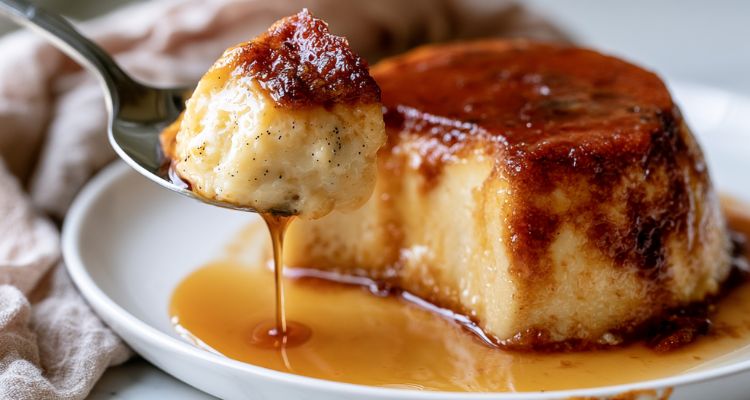
- Chill and serve: Remove the ramekins from the water bath and allow to cool completely. Refrigerate overnight so the caramel and custard fully combine. To serve, dip each ramekin briefly in hot water, run a knife around the inside edge, place a plate over the top, and invert firmly. Decorate with the remaining lavender flowers.
FAQs
Why does Ramsay take the milk off the heat just before it boils?
Scalded milk that crosses into a full boil begins to change protein structure, and those proteins scramble the eggs on contact when you pour. Just-below-boiling is hot enough to gently cook the custard mix but gentle enough not to curdle it. His note in the book is specific: “just below scalding point,” not simmering, not boiling.
Why does he whisk the eggs and sugar at the last minute?
Sugar draws moisture out of egg yolks through osmosis. Leave them sitting together for even 5-10 minutes before you add the milk, and the yolks start to break down and go grainy. Whisking right before the milk arrives means the eggs go into the custard at full strength.
How is this different from a standard Spanish-style flan?
The Spanish version uses sweetened condensed milk and evaporated milk, which makes it denser and sweeter. Ramsay’s uses whole milk only, so the custard is lighter and the egg and vanilla flavor comes through more clearly. The lavender sugar is also entirely absent from any Latin-style flan, which is why the flavor sits closer to a French crème brûlée baked in ramekins than to the flan most people grew up with.
Why do the ramekins need to be greased with butter after the caramel sets?
The caramel grips the bare ramekin wall, so the custard doesn’t release cleanly without it. A thin layer of butter between the set caramel and the custard acts as a slip coat when you invert the ramekin. Skip it and the top edge of the custard tears on the way out. Ramsay specifies to do this only after the caramel has cooled and hardened, not before, so the butter doesn’t melt into the hot caramel and break it.
What else uses the same bain-marie technique?
The bain-marie is the same method Ramsay uses for his panna cotta with a water bath, where gentle, indirect steam heat is the only way to get a custard-style dessert to set without cracking or curdling on the surface. Both rely on the same principle: the water around the ramekins never exceeds 212F (100C), which keeps the custard from ever getting hot enough to cook unevenly.
Zaytouna Studio Team is the kitchen team behind Chef Ramsay Recipes. We cook Gordon Ramsay’s recipes from his cookbooks and videos in a home kitchen and write them up for yours, with US and metric measurements.