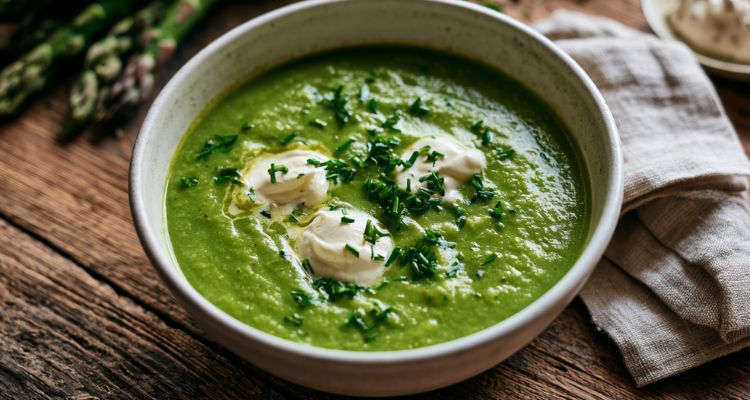

Gordon Ramsay’s asparagus soup is a silky, vibrant green puree made with 2 lbs (1kg) of fresh asparagus, finished with a whipped truffle cream that takes it from simple to stunning. It comes together in about 35 minutes.
This recipe appears as “Asparagus Soup with Truffle Cream” in Gordon Ramsay’s Secrets, where he writes, “Make this soup in the spring when homegrown asparagus is in season and available at a good price. You don’t need to seek out young, tender spears: it’s the flavour you need, not the texture.” He even recommends using woody ends and peelings rather than throwing them away.
The technique that separates this from other asparagus soups: he adds a handful of baby spinach just before blending, then passes everything through a fine sieve. The spinach deepens the green colour without changing the taste, and sieving removes every fibre so the texture is completely smooth.
Gordon Ramsay Asparagus Soup Recipe
Course: SoupsCuisine: British, AmericanDifficulty: Easy4
15
minutes20
145
kcal35
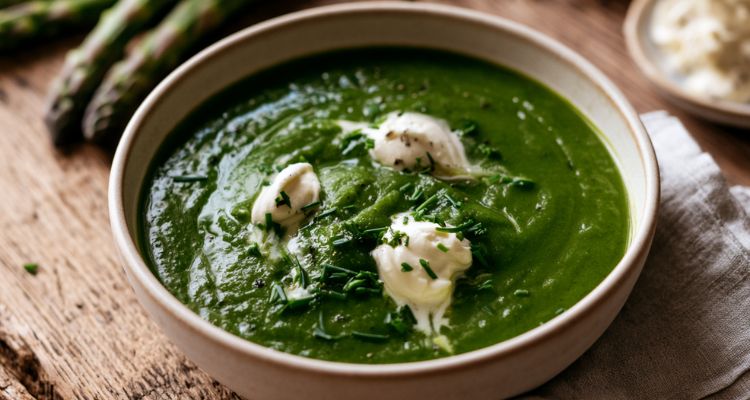
Spring asparagus soup from Gordon Ramsay’s Secrets, pureed until silky and passed through a sieve for restaurant-level smoothness. Topped with double cream lightly whipped with truffle oil and snipped chives, which melts slowly into each spoonful.
Ingredients
- Soup:
2 lbs (1kg) green asparagus, including trimmings if available
1/3 cup (75g) butter
1 onion, chopped
1 fat garlic clove, chopped
3 cups (750ml) chicken stock or vegetable stock
3 1/2 oz (100g) baby leaf spinach
Sea salt and freshly ground black pepper
- Truffle cream:
2/3 cup (150ml) heavy cream (double cream)
1/2 tsp truffle oil
2 tsp finely chopped chives
Directions
- Prep the asparagus: Chop the asparagus into small, even-sized pieces. Don’t discard the woody ends because they carry just as much flavour as the tips and will be pureed and sieved out later.
- Sweat the aromatics: Heat the butter in a large saucepan and, when it starts to sizzle, add the onion and garlic. Sauté gently for about 10 minutes until softened but not coloured. Don’t let them brown because any colour will muddy the bright green finish.
- Cook the asparagus: Add the asparagus pieces to the pan and sauté for a further 5 to 10 minutes until softened.
- Add the stock: Meanwhile, bring the chicken stock or vegetable stock to a boil in a separate pan. Pour the hot stock over the asparagus, season to taste and simmer for 3 minutes.
- Wilt the spinach: Stir in the baby spinach and cook briefly until just wilted. Immediately remove from the heat and strain the stock, reserving the vegetables and the liquor separately.
- Puree and sieve: Transfer the vegetables to a blender or food processor and whiz until smooth, gradually adding the reserved stock back until you have a creamy liquid. This is best done in stages to ensure a very smooth texture. Pass the soup through a fine sieve into a clean pan, rubbing the pulp with the back of a ladle to extract as much flavour as possible.
- Make the truffle cream: Lightly whip the heavy cream (double cream) with the truffle oil and a pinch of seasoning until softly peaking. Don’t over-whip because you want it to melt into the hot soup, not sit on top like a stiff dollop.
- Serve: Reheat the soup gently until almost at a simmer, but do not boil or you will destroy the colour and flavour. Ladle into warmed bowls, top with dollops of truffle cream and scatter over the chopped chives.
FAQs
Why does Ramsay add spinach to an asparagus soup?
Asparagus puree on its own often turns a dull olive green once it’s been cooked and blended. Stirring in a handful of baby spinach just before blending boosts the colour to a much brighter, more vibrant green.
The trick works because spinach wilts in seconds and has a mild enough flavour that it doesn’t compete with the asparagus. You’d never know it was there by taste, but you’d notice the difference by sight. Ramsay uses the same spinach-for-colour technique in his watercress soup in the same chapter of Secrets.
Why does he pass the soup through a sieve after blending?
Asparagus has tough, stringy fibres running through the stalks, especially the woody lower portions. A blender breaks them down but can’t eliminate them completely, so the texture stays slightly grainy.
Passing everything through a fine sieve catches those fibres and any remaining pulp. You push the mixture through with the back of a ladle to extract maximum flavour while leaving the roughage behind. It’s an extra step, but it’s the difference between homemade and restaurant-quality texture.
Why use hot stock instead of adding cold stock to the pan?
Pouring already-boiling stock over the sweated asparagus means the soup comes back up to temperature almost instantly. The asparagus only simmers for 3 minutes after that, which is enough to soften it for blending but short enough to preserve its fresh, grassy flavour.
Cold stock would need time to heat up, and the asparagus would sit in the pan cooking the whole time. That extended heat dulls the colour and pushes the flavour toward something flat and cabbage-like. Speed matters here, which is why Ramsay heats the stock in a separate pan while the asparagus sweats.
Why does he say not to boil the soup when reheating?
Asparagus soup loses its bright green colour and fresh flavour when it hits a full boil. The chlorophyll in the asparagus and spinach breaks down rapidly at high temperatures, turning the soup from vivid green to a muddy brownish tone.
Gentle reheating, just below a simmer, keeps everything intact. This is also why the initial cooking time is so short: 3 minutes of simmering, spinach wilted for just seconds. Every step in this recipe is built around protecting that colour and brightness.
How is this different from his Vietnamese asparagus soup in Great Escape?
Completely different dish. The Great Escape: Southeast Asia version is a Vietnamese crab and asparagus soup called Sup Mang Tay Cua, where asparagus stalks simmer in stock with fish sauce, beaten eggs are swirled in to form silky strands, and sautéed crab is spooned on top.
The Secrets version is a classic European puree: butter, onion, garlic, blended smooth and sieved. One is light and brothy with Asian aromatics, the other is rich and velvety with truffle cream. If you enjoy Ramsay’s approach to roasted tomato soup with its layered technique, this asparagus soup follows the same philosophy.
Can cheaper asparagus work just as well as premium spears?
Ramsay is clear on this: “You don’t need to seek out young, tender spears: it’s the flavour you need, not the texture.” Since everything gets pureed and sieved, thick or woody stalks work just as well as slim, tender ones.
This makes it a smart recipe for using up the ends you’d normally trim and discard when serving asparagus as a side. Buy it in season during spring when prices drop and flavour peaks. Out of season asparagus tends to taste watery and bland, and no amount of truffle cream will fix that. If you’re looking for another spring soup, his leek and potato soup pairs well on a seasonal menu.

I’m Ava Taylor. I’m A Self-taught Home Cook Who Loves Gordon Ramsay Recipes. I Try Every Dish In My Small Apartment Kitchen And Tweak It Until It Works. I Write Clear Steps With Simple Words So Anyone Can Follow. I Share Honest Wins, Mistakes, And Quick Tips To Help You Cook With Confidence.