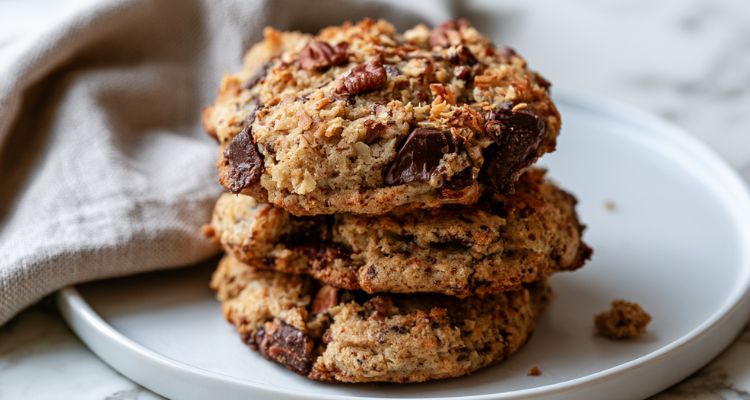

Gordon Ramsay’s cowboy cookies are thick, chewy drop cookies loaded with old-fashioned oats (rolled oats), semi-sweet chocolate chips, toasted pecans, and flaked coconut, all built on a brown butter dough. They take about 35 minutes start to finish and make around 24 large cookies.
This recipe adapts the technique from Ramsay’s Walnut Chocolate Chip Cookies in Gordon Ramsay: Bread Street Kitchen, where he uses brown sugar only, no white, and folds in chunky mix-ins right at the end so the dough doesn’t get overworked. The cowboy cookie additions, oats, coconut, and pecans, follow his same principle: every add-in should add texture or contrast, not just volume.
The one technique that separates these from every flat, greasy cowboy cookie you’ve had before: brown the butter instead of creaming softened butter. Browning drives off the water in the butter and caramelizes the milk solids, which builds a deep, nutty flavor into the base before a single mix-in touches the bowl.
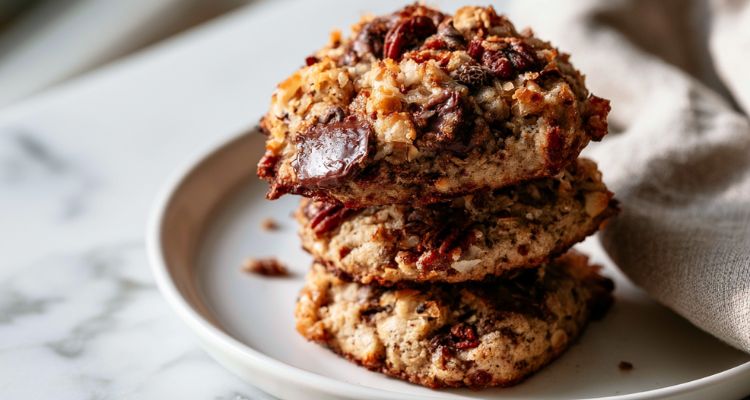
Gordon Ramsay Cowboy Cookies Recipe
Course: DessertsCuisine: BritishDifficulty: Easy24
15
minutes12
290
kcalAdapted from Ramsay’s chunky cookie method in Bread Street Kitchen, with oats, coconut, pecans, and chocolate chips built into his brown sugar dough. The brown butter step is the key technique, turning an already solid cookie base into something with real depth.
Ingredients
- Dough
1 cup (225g) unsalted butter
1 cup (200g) light soft brown sugar (light muscovado)
½ cup (100g) dark soft brown sugar
2 large eggs, room temperature
2 tsp vanilla extract
2⅓ cups (270g) all-purpose flour (plain flour)
1 tsp baking soda (bicarbonate of soda)
1 tsp ground cinnamon
½ tsp fine sea salt
- Mix-ins
1¾ cups (156g) old-fashioned rolled oats, not instant
¾ cup (60g) sweetened flaked coconut
½ cup (64g) pecans, roughly chopped and lightly toasted
12 oz (340g) semi-sweet chocolate chips (dark chocolate chips)
1 tsp flaky sea salt, for finishing (Maldon works well)
Directions
- Brown the butter: Melt the butter in a light-colored saucepan over medium heat, stirring constantly. It will foam, then the foam will settle. Keep stirring until the butter turns amber and smells nutty, about 4-5 minutes. Pour it immediately into a large mixing bowl and let it cool for 10 minutes. Don’t let it sit in the pan or it keeps cooking.
- Build the dough: Add both sugars to the cooled brown butter and whisk until combined. Add the eggs one at a time, whisking well after each, then add the vanilla. Sift over the flour, baking soda, cinnamon, and salt, and fold in until just combined. Stop as soon as you don’t see dry flour. Overmixing activates the gluten and toughens the cookies.
- Fold in the mix-ins: Add the oats, coconut, pecans, and chocolate chips. Fold with a spatula until evenly distributed. The dough will be thick. If your kitchen is warm, cover and chill the bowl for 15-30 minutes so the cookies don’t spread too flat.
- Portion and bake: Preheat the oven to 350°F (175°C). Line two baking sheets with parchment. Scoop the dough into balls about 3 tablespoons each, roughly the size of a golf ball, and place them 3 inches apart. Flatten slightly with your palm. Bake for 11-12 minutes, until the edges are golden but the centers still look underdone. They finish setting as they cool.
- Cool and finish: Sprinkle flaky salt over the cookies the moment they come out of the oven. Let them cool on the tray for 8-10 minutes before moving to a wire rack. They firm up as they cool, so don’t judge them straight from the oven.
FAQs
Why brown butter instead of creaming softened butter?
Ramsay’s cookie base in Bread Street Kitchen uses softened butter creamed with sugar. Brown butter takes that a step further because heating the butter until it’s amber drives off all the water content and caramelizes the milk solids, building a toasted, almost toffee-like flavor into the fat itself. That flavor goes into every bite.
Creamed butter gives you a lighter, airier dough. Brown butter gives you a denser, chewier cookie with more flavor depth. For a cookie with this many mix-ins, you want the denser base. A light, airy dough gets overwhelmed by oats and coconut.
The practical point: use a light-colored pan so you can see the color change. A dark pan hides the browning and you can’t tell when it’s done.
Why old-fashioned rolled oats instead of instant?
Instant oats are pre-cooked and rolled thinner, so they dissolve into the dough and disappear. You lose the chew entirely. Old-fashioned rolled oats keep their structure through the bake and give the cookie that thick, slightly rough texture that makes cowboy cookies different from a regular chocolate chip.
Ramsay’s approach with his walnut chocolate chip cookies is to keep chunky add-ins chunky. Chopped dark chocolate, not chips. Rough walnut pieces, not fine. Same principle applies here: the texture contrast between chewy oat and soft center is the point.
If all you have is quick oats, they will work, but the cookies will be softer and more uniform, closer to a standard drop cookie than a cowboy cookie.
Why two types of brown sugar instead of a mix of brown and white?
White sugar makes cookies spread wider and crisper because it melts faster and holds less moisture. Brown sugar has molasses in it, which is hygroscopic, meaning it pulls moisture from the air and keeps it in the cookie. More brown sugar means a chewier, denser, moister result even after they cool.
Using two types of brown sugar, light and dark, layers the molasses flavor. Light brown gives you mild caramel notes. Dark brown pushes toward treacle and toffee. Together they add a depth to the base that white sugar simply doesn’t.
Ramsay uses light soft brown sugar only in his Bread Street Kitchen cookies. The adaptation here adds dark brown sugar to match the intensity of the coconut and chocolate.
Why does the center need to look underdone when you pull them from the oven?
Cookies continue cooking on the hot tray after they come out. The tray retains heat for several minutes, and the residual warmth finishes the center without drying it out. If the center looks fully set in the oven, by the time the cookie cools it will be overcooked and dry.
This is the same logic Ramsay uses in his ten-minute cookies, where he specifies pulling them at golden edges only, not golden all over. The visual cue is the edge, not the center. Golden rim, soft middle, that’s the pull point.
Eight to ten minutes on the tray after baking is the minimum rest. Moving them early breaks them apart because the structure hasn’t fully set yet.
Why toast the pecans before adding them to the dough?
Raw pecans taste mild and slightly bitter. Toasting them in a dry pan for 3-4 minutes releases their natural oils and deepens the flavor significantly, bringing out a buttery, almost caramel note that raw nuts don’t have. For a chocolate and oat-heavy cookie where a lot of things are competing for attention, that extra flavor from the nuts matters.
It also improves the texture. Toasted nuts stay crunchier through the bake. Raw nuts soften more in the oven heat, especially with the moisture from the dough, and can end up chewy in a way that blurs into the oats.
If you’re already making walnut chocolate chip cookies, the same toasting step applies there too.
Can you freeze the dough and bake later?
Yes, and Ramsay specifically recommends this in Bread Street Kitchen as a way to have cookies ready when people show up unexpectedly. Roll the dough into a log, wrap it tightly in plastic wrap (cling film), and freeze for up to a month. Slice into rounds about 1cm thick straight from frozen and bake at 350°F (175°C), adding 1-2 minutes to the bake time since the dough is cold.
For cowboy cookies, scooping into balls and freezing individually on a tray works better than a log, because the mix-ins make clean slicing difficult. Once the balls are frozen solid, transfer them to a sealed bag.
If you enjoy oatmeal cookies as well, the same freeze-and-bake method works for that dough too.

I’m Ava Taylor. I’m A Self-taught Home Cook Who Loves Gordon Ramsay Recipes. I Try Every Dish In My Small Apartment Kitchen And Tweak It Until It Works. I Write Clear Steps With Simple Words So Anyone Can Follow. I Share Honest Wins, Mistakes, And Quick Tips To Help You Cook With Confidence.