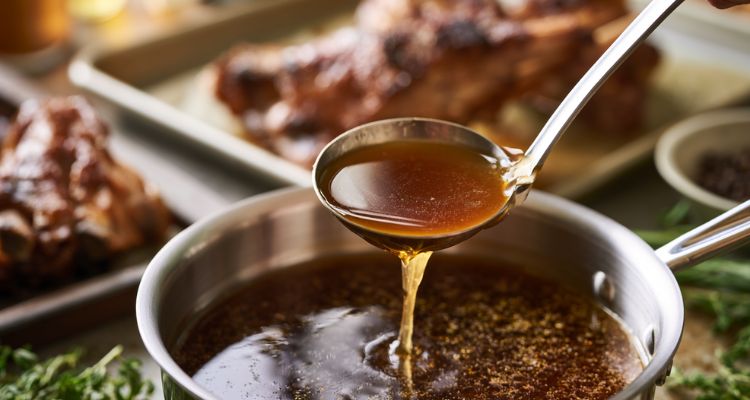

Gordon Ramsay’s lamb stock starts with roasted lamb bones, browned vegetables and white wine, simmered for 4 to 6 hours until rich and deeply savoury. It makes about 5 cups (1.2 litres) of concentrated stock that transforms any lamb dish you use it in.
This recipe comes from Gordon Ramsay’s Great British Pub Food, where he roasts the bones at high heat first, then builds the liquid separately with browned aromatics, tomato purée and wine before combining everything. A second version in Passion for Flavour uses the same technique at restaurant scale, noting that “rib or neck of lamb bones” work best “but shoulder or leg bones are also fine.”
The technique that makes this stock worth the time: Ramsay browns the vegetables in a separate stockpot while the bones roast, then deglazes the pot with wine before adding the bones. This means the caramelised vegetable sugars and the wine reduction are already in the liquid when the bones go in, so the stock builds flavour from two directions at once instead of one.
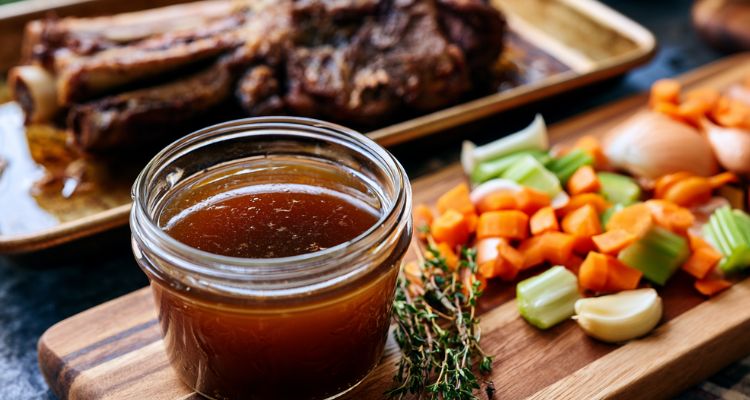
Gordon Ramsay Lamb Stock Recipe
Course: SoupsCuisine: BritishDifficulty: Easy5
15
minutes5
15
minutes240
5
hours30
A slow-simmered brown lamb stock from Gordon Ramsay’s Great British Pub Food, built on roasted bones, caramelised vegetables and white wine. His Passion for Flavour version uses the same method at twice the scale, reducing 8 litres down to 2 for an even more concentrated result.
Ingredients
2.2 lbs (1kg) lamb rib or neck bones, cut into small pieces
4 tbsp (60ml) olive oil
1 onion, peeled and chopped
2 carrots, peeled and chopped
1 celery stick, chopped
1/2 head of garlic, split horizontally
1 1/2 tsp tomato purée (tomato paste)
1/3 cup (75ml) dry white wine
8 1/2 cups (about 2 litres) cold water
1 bay leaf
A few thyme sprigs
A few flat-leaf parsley sprigs
1 tsp black peppercorns
Directions
- Roast the bones: Preheat the oven to 430°F (220°C/Gas 7). Spread the lamb bones out in a large roasting tin and drizzle with a little of the olive oil to coat. Roast for 45 to 60 minutes, turning halfway, until evenly browned all over. Deep colour on the bones means deep flavour in the stock, so don’t pull them early.
- Brown the vegetables: While the bones roast, heat the remaining oil in a large stockpot. Add the onion, carrots, celery and garlic, and cook over high heat, stirring occasionally, until golden brown. Add the tomato purée and cook for 2 minutes, stirring so it doesn’t catch.
- Deglaze with wine: Pour in the white wine and let it bubble until reduced by half. The wine lifts all the caramelised bits from the bottom of the pot and adds acidity that balances the richness of the bones.
- Combine and simmer: Add the browned bones to the pot, being careful not to pour in any fat from the roasting tin. Pour in enough cold water to cover, about 8 1/2 cups (2 litres). Bring to a simmer and skim off the froth and scum that rise to the surface. Add the bay leaf, thyme, parsley and peppercorns.
- Cook low and long: Simmer the stock gently for 4 to 6 hours, until you are happy with the flavour. Check it occasionally and skim off any fat or scum that collects on the surface. The longer it simmers, the more concentrated and savoury the stock becomes.
- Strain and store: Let stand for a few minutes, then pass through a fine sieve into a clean bowl. Let cool, then refrigerate. Once chilled, any remaining fat will set on the surface and can be lifted off easily. Use fresh stock within 5 days, or freeze in smaller amounts for up to 3 months.
FAQs
Why does Ramsay roast the bones before making stock?
Raw bones produce a pale, mild stock. Roasting them at high heat for 45 to 60 minutes triggers browning reactions that create hundreds of new flavour compounds on the surface. When those roasted bones hit the simmering liquid, all of that flavour dissolves into the stock.
This is the difference between a white stock and a brown stock. Ramsay makes both in his restaurants, but for lamb he always goes brown. Lamb has a stronger natural flavour than chicken, and roasting pushes it further into rich, savoury territory that works better in braises, sauces and hearty soups like his lentil soup.
Why brown the vegetables separately instead of roasting them with the bones?
Roasting bones and vegetables together in the same tin means the vegetables sit in rendered lamb fat for nearly an hour. They absorb that grease instead of caramelising cleanly, and the stock ends up heavy and greasy no matter how well you skim it.
Browning the vegetables in a stockpot gives you control over their colour and lets you deglaze the pot with wine before the bones go in. That wine reduction becomes part of the stock’s foundation, which wouldn’t happen if everything went into the oven together.
What’s the difference between the Pub Food and Passion for Flavour versions?
The Pub Food version starts with 2.2 lbs (1kg) of bones and 2 litres of water, yielding about 1.2 litres of stock after 4 to 6 hours. It’s scaled for home cooking and produces enough for one or two recipes.
The Passion for Flavour version doubles the bones to 4.4 lbs (2kg) and starts with 8 litres of water, which Ramsay reduces down to just 2 litres. That extra reduction concentrates the flavour dramatically, giving you a stock intense enough for restaurant-quality sauces. If you want something between the two, reduce the Pub Food version by an extra third after straining.
Which lamb bones give the best stock?
Ramsay specifies rib or neck bones as his preference in both books, but notes in Passion for Flavour that “shoulder or leg bones are also fine.” Rib and neck bones have more connective tissue and cartilage, which breaks down during the long simmer and gives the stock body and a slight richness that sets to a jelly when chilled.
Leg bones are denser and produce a cleaner, thinner stock. If your butcher has them, ask for the bones to be cut into small pieces so more surface area is exposed to the heat during roasting. Smaller pieces also fit more easily into the stockpot.
How do you know when the stock is ready?
Ramsay’s instruction is to simmer “until you are happy with the flavour,” which means tasting it. At 4 hours the stock will be good. At 6 hours it will be more concentrated and savoury. Beyond that, you risk bitterness from the bones breaking down too far.
The other test is body. Dip a spoon into the stock and let it cool for a moment. If it coats the back of the spoon with a slight stickiness, the collagen from the bones has dissolved into the liquid and the stock will have a silky texture when you use it. Thin, watery stock that runs straight off the spoon needs more time.
How should you store and reheat lamb stock?
Ramsay gives specific guidance in Passion for Flavour: the stock keeps up to a week in a sealed container in the fridge, “provided it is brought to the boil for a few minutes every 3-4 days.” That reboiling kills any bacteria that develop during storage and resets the clock.
For longer storage, freeze in usable portions. Ice cube trays work well for small amounts you can drop into a bean soup or pan sauce. Larger containers suit braises and stews. Both books agree on a maximum of 2 to 3 months frozen. Always remove the fat layer from the surface before freezing because it can turn rancid faster than the stock beneath it.

Zaytouna Studio Team is the kitchen team behind Chef Ramsay Recipes. We cook Gordon Ramsay’s recipes from his cookbooks and videos in a home kitchen and write them up for yours, with US and metric measurements.