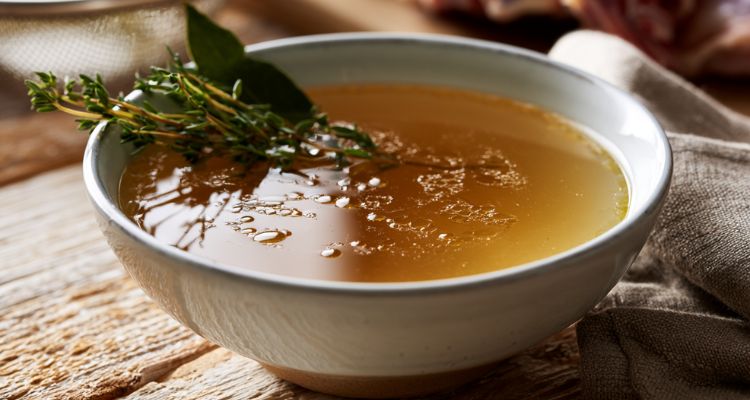

Gordon Ramsay’s chicken broth is a clean, golden stock built from raw chicken bones, sautéed vegetables, tomato purée, and fresh herbs, simmered for just one hour. It’s the foundation he uses across nearly every cookbook he’s written.
This recipe appears in Gordon Ramsay’s Great British Pub Food, and versions of it run through Fast Food, Make It Easy, and Sunday Lunch with almost no variation. He keeps it in his basics chapter because, as he puts it, fresh stocks “will make all the difference to the flavour of a dish.”
The technique that matters: he sautés the vegetables until golden before adding the bones. Most home cooks dump everything into cold water together, but cooking the aromatics first builds a caramelised base that gives the broth a rounder, deeper flavour than a pale, raw-start stock ever could.
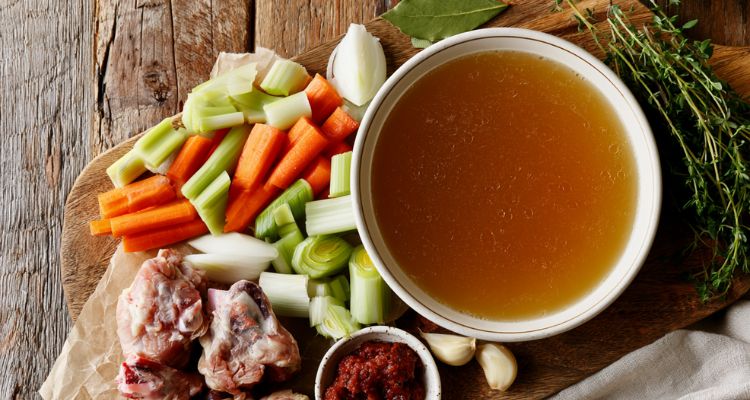
Gordon Ramsay Chicken Broth Recipe
Course: SoupsCuisine: BritishDifficulty: Easy4-6
10
minutes1
40
kcal1
10
minutesFrom the Basics chapter of Great British Pub Food, with cross-references from Fast Food, Make It Easy, and Sunday Lunch. Ramsay calls this “chicken stock” and uses it as the backbone for his soups, sauces, and braises across all four books.
Ingredients
2 tablespoons olive oil
1 large carrot, peeled and chopped
1 onion, peeled and chopped
2 celery stalks (sticks), trimmed and chopped
1 leek, trimmed and sliced
1 bay leaf
1 thyme sprig
3 garlic cloves, peeled
2 tablespoons tomato paste (tomato purée)
2 1/4 lbs (1kg) raw chicken bones
About 8 1/2 cups (2 litres) cold water
Sea salt and black pepper
Directions
- Sauté the vegetables: Heat the olive oil in a large stockpot. Add the carrot, onion, celery, leek, bay leaf, thyme, and garlic cloves. Cook over medium heat, stirring occasionally, until the vegetables are golden. This colour is flavour, so don’t rush it.
- Add the paste: Stir in the tomato purée and cook for another minute. This deepens the savoury backbone of the broth.
- Build the broth: Add the raw chicken bones, then pour in enough cold water to cover, about 8 1/2 cups (2 litres). Season lightly with salt and pepper. Starting with cold water is important because it draws out more flavour from the bones as the temperature rises slowly.
- Skim and simmer: Bring to the boil and skim off any scum that rises to the surface. Reduce the heat and leave to simmer gently for 1 hour. Don’t let it boil hard or the broth turns cloudy.
- Strain and cool: Let the stock stand for a few minutes to cool slightly, then pass through a fine sieve (strainer) into a bowl. Discard the solids. Let cool completely before refrigerating.
Notes
- Storage: Refrigerate and use within 5 days, or freeze in convenient portions for up to 3 months.
FAQs
Why does Ramsay call this “stock” and not “broth”?
Ramsay labels this recipe “chicken stock” in all four books. In professional kitchens, stock is made from bones while broth is made from meat. The distinction matters less at home because his version produces something you’d use exactly the way most people use broth: as a soup base, a braising liquid, or sipped on its own.
The bones are what give this recipe its body. They release collagen as they simmer, which is why good homemade stock turns slightly jellied in the fridge. That gelatin is what makes his mushroom soup and butternut squash soup taste richer than versions made with a stock cube.
What is his brown chicken stock variant?
Every book that includes his standard stock also includes a brown version. The only change: roast the chicken bones in a roasting tin at 400°F (200°C) for 20 minutes before adding them to the pot. Everything else stays the same.
Ramsay says this gives “a greater depth of flavour than ordinary chicken stock.” The roasting caramelises the proteins on the bone surfaces, which adds a darker colour and a more intense, almost meaty taste. Use it for gravies, rich braises, and anything where you want the stock to stand out rather than sit in the background.
Why does he sauté the vegetables before adding water?
Dumping raw vegetables and bones into cold water is simpler, but you skip the most important flavour step. Cooking the aromatics in oil until golden triggers the Maillard reaction on their surfaces, which creates hundreds of new flavour compounds that dissolve into the liquid as it simmers.
Think of it like the difference between boiled onions and fried onions. Same ingredient, completely different taste. That golden colour on the vegetables translates directly into a richer, more complex broth.
Why does he add tomato purée to a chicken broth?
The tomato purée isn’t there for tomato flavour. Two tablespoons in 2 litres of water is too little to taste as tomato. What it adds is glutamate, which deepens the savoury, umami quality of the finished broth.
His Fast Food and Sunday Lunch versions also stir in two tablespoons of flour at this stage, which gives the stock a slightly fuller body. If you want a thicker broth for sauces or gravies, add the flour. For a cleaner, lighter broth for soups like his chicken noodle soup, leave it out.
Why only one hour of simmering?
Most traditional stock recipes call for 3 to 4 hours. Ramsay keeps his at one hour because chicken bones are smaller and thinner than beef bones, so they release their collagen and flavour faster. Longer simmering doesn’t extract more goodness: it just breaks down the vegetables until they turn bitter and muddy the taste.
One hour also makes this a realistic weeknight task. You can start it while prepping dinner, strain it before you eat, and have it cooled and in the fridge by bedtime.
How can you tell if the broth turned out well?
The best test is the fridge test. Cool the broth completely, then refrigerate it overnight. Good broth sets into a soft, wobbly jelly because of the gelatin extracted from the bones. If it’s still liquid, the bones didn’t release enough collagen, usually because the simmer was too short or there weren’t enough bones for the amount of water.
A layer of fat will solidify on top. Lift it off before using the broth, or leave a thin layer for extra richness in soups like his roasted tomato soup.

Zaytouna Studio Team is the kitchen team behind Chef Ramsay Recipes. We cook Gordon Ramsay’s recipes from his cookbooks and videos in a home kitchen and write them up for yours, with US and metric measurements.