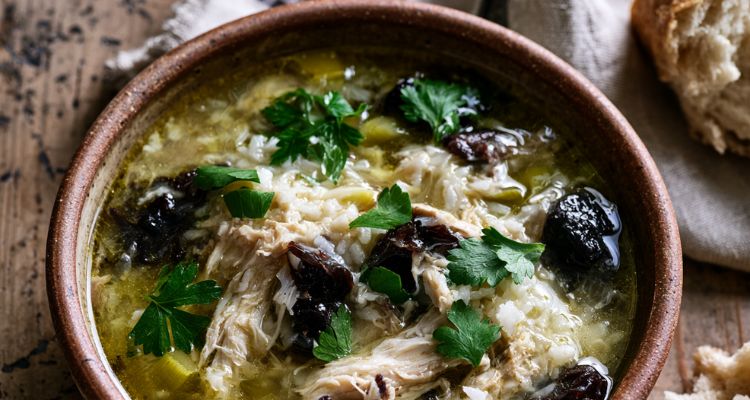

Gordon Ramsay’s chicken soup is a classic cock-a-leekie: a whole jointed chicken simmered low and slow in stock with leeks, soft prunes and rice until the broth is rich and the meat falls apart. It takes about 90 minutes, mostly hands-off.
This recipe appears as “Cock-a-leekie Soup” in Gordon Ramsay’s Great British Pub Food, where he writes, “This winter warmer is traditionally served as a starter at Scottish holiday feasts, including Hogmanay and Burns Night.” He notes that prunes add a mild sweetness to the savoury broth, though you can leave them out if you prefer.
The technique that sets this apart from most chicken soups: he simmers the chicken on the lowest possible heat so the surface of the liquid barely moves. That gentle poach keeps the meat tender and the broth clear rather than cloudy, which is the difference between a refined soup and something that looks like it boiled over.
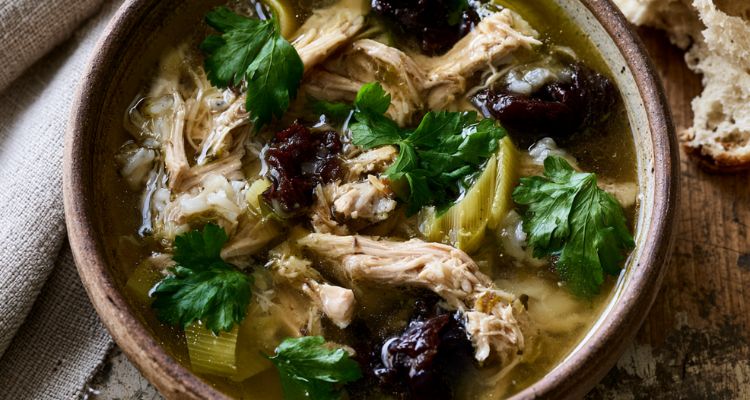
Gordon Ramsay Chicken Soup Recipe
Course: SoupsCuisine: American, BritishDifficulty: Easy6
15
minutes15
320
kcalScottish cock-a-leekie from Gordon Ramsay’s Great British Pub Food, built on a whole jointed chicken poached gently in stock with a bouquet garni. Leeks go in halfway through, then rice and prunes thicken the broth and add a subtle sweetness you won’t find in any other chicken soup.
Ingredients
1 whole chicken, about 3 1/3 lbs (1.5kg), jointed
Sea salt and black pepper
1 bouquet garni (bay leaf, a few thyme and parsley sprigs, tied together)
6 1/3 to 8 1/2 cups (1.5-2 litres) chicken stock, or water
5 large leeks, about 1 lb (500g) in total, trimmed
7 oz (200g) cooked rice
7 oz (200g) soft pitted prunes
Directions
- Season and submerge the chicken: Rub the chicken joints with salt and pepper and place in a large cooking pot with the bouquet garni and stock. If the stock doesn’t quite cover the chicken, top up with cold water. Add a generous pinch each of salt and pepper and bring the liquid to a simmer.
- Skim and slow-simmer: Skim off any froth or scum that rises to the surface. Turn the heat to the lowest setting, partially cover the pan and simmer gently for 30 minutes. The surface of the liquid should barely move. This gentle poach is what keeps the broth clear and the chicken tender.
- Add the leeks: Slice the leeks on the diagonal into 1/2 to 3/4 inch (1-2cm) wide pieces. Add them to the pan and simmer for a further 30 minutes until the chicken is tender throughout.
- Shred the chicken: Lift the chicken out of the stock and leave until cool enough to handle. Meanwhile, add the rice and prunes to the stock and simmer for another 15 to 20 minutes. Remove the bouquet garni.
- Finish and serve: Shred the chicken meat, discarding the skin and bones, then return to the stock to warm through. Taste and adjust the seasoning. Ladle the soup into warm soup plates to serve.
FAQs
Why does Ramsay use a whole jointed chicken instead of just breasts or thighs?
A whole chicken gives you a mix of white and dark meat, which means more depth of flavour in the broth. The bones and joints release collagen as they simmer, which gives the liquid body and a slight richness that boneless cuts can’t deliver.
Dark meat from the legs and thighs also holds up better during the long simmer without drying out. If you used breast meat alone, you’d get tender pieces for the first 20 minutes and chalky, stringy ones by the time the broth has developed properly.
Why does he simmer so gently that the surface barely moves?
A hard boil breaks the chicken apart too quickly and forces fat and proteins into the liquid, which makes it cloudy and greasy. A gentle simmer keeps everything intact while still extracting flavour from the bones and aromatics.
This is the same principle behind any good stock. Ramsay’s approach to his chicken noodle soup uses a similar low heat for the broth, because clarity and clean flavour come from patience, not temperature.
Why add prunes to a chicken soup?
Prunes are traditional in cock-a-leekie and they do more than you’d expect. Their mild sweetness balances the savoury broth and the peppery leeks, creating a rounded flavour that straight chicken-and-vegetable soup doesn’t have.
They also soften during the simmer and break down slightly, which adds a subtle body to the liquid. Ramsay notes you can leave them out if you prefer, but the soup loses that sweet-savoury contrast that makes the Scottish version distinct from a basic chicken broth.
Why add pre-cooked rice instead of cooking raw rice in the broth?
Raw rice absorbs a huge amount of liquid as it cooks, which would thicken the soup into something closer to a porridge. It also releases starch that clouds the broth.
Using pre-cooked rice means the grains just warm through and hold their shape without soaking up all the stock. The broth stays light and clear while the rice adds substance to each spoonful. If you’re making this ahead, keep the rice separate and add it when you reheat because it will continue absorbing liquid as it sits.
How is this different from a standard chicken noodle soup?
Cock-a-leekie is a slower, more rustic approach. The chicken simmers on the bone for over an hour so the broth develops real depth, while most chicken noodle soups use pre-cooked or quick-poached chicken and focus on the noodles.
The flavour profile is also completely different. Leeks and prunes give this a Scottish sweetness that you won’t find in a noodle soup built on carrots, celery and herbs. And the rice makes it feel hearty without the starchiness that noodles add. If you want something lighter with an Asian angle, Ramsay’s Tom Kha Gai takes chicken soup in a completely different direction with coconut and galangal.
Can the leeks be swapped for onions?
Leeks are the whole point of cock-a-leekie, so swapping them changes the dish fundamentally. They have a milder, sweeter flavour than onions and they soften into silky ribbons during the long simmer rather than breaking down into mush.
If you can’t find leeks, the closest option is spring onions (scallions) added in the last 10 minutes, but the result is a different soup. Onions would make a fine chicken broth, just not a cock-a-leekie.

Zaytouna Studio Team is the kitchen team behind Chef Ramsay Recipes. We cook Gordon Ramsay’s recipes from his cookbooks and videos in a home kitchen and write them up for yours, with US and metric measurements.