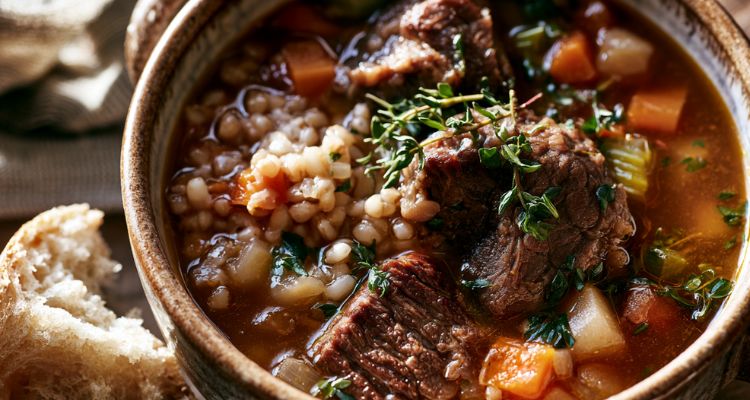

Gordon Ramsay’s beef barley soup is a slow-braised broth of beef shin, pearl barley, and root vegetables simmered for about 4 hours until the meat falls apart. It feeds 6-8 for the price of a cheap cut and a bottle of beer.
This is adapted from the Hodge Podge Soup in Gordon Ramsay’s Great British Pub Food, where he notes that “pearl barley can be used to bulk up the soup instead of potato if you prefer.” The barley quantity and timing follow his Welsh Mutton Broth from the same chapter. No exact beef barley soup exists in his cookbooks, so this combines both recipes transparently.
The technique that sets it apart: he deglazes the browned meat and vegetables with a full bottle of light beer before adding stock. The beer reduces by half and leaves a malty depth underneath the beef that stock alone can’t match.
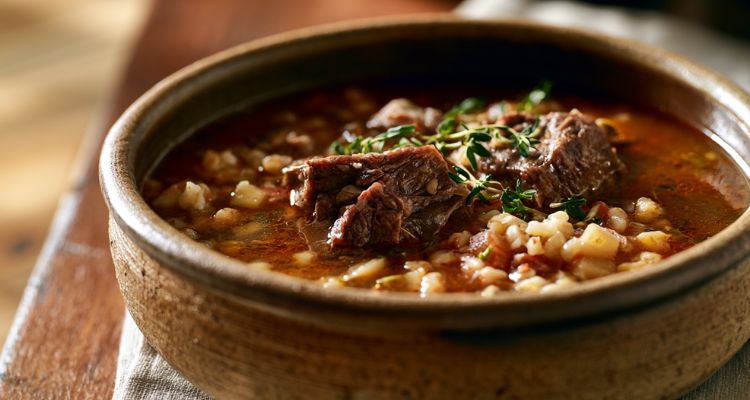
Gordon Ramsay Beef Barley Soup Recipe
Course: SoupsCuisine: BritishDifficulty: Easy6-8
20
minutes4
320
kcal4
20
minutesA slow-braised beef shin and pearl barley soup built from two recipes in Gordon Ramsay’s Great British Pub Food. The Hodge Podge Soup provides the beef base, the Welsh Mutton Broth provides the barley technique. Most of the 4 hours is hands-off simmering.
Ingredients
1 3/4 lbs (800g) boneless beef shin, trimmed of excess fat, cut into small bite-sized pieces
3 tbsp olive oil
Sea salt and black pepper
1 large onion, peeled and diced into 3/4 inch (2cm) pieces
1 large carrot, peeled and diced into 3/4 inch (2cm) pieces
1 medium turnip, peeled and diced into 3/4 inch (2cm) pieces
2 celery stalks (sticks), trimmed and diced into 3/4 inch (2cm) pieces
1 x 11 oz (330ml) bottle light beer or cider
2 cups (500ml) beef stock
A few thyme sprigs, plus extra leaves to garnish
1 bay leaf
2/3 cup (125g) pearl barley
3/4 oz (20g) butter, softened
3/4 oz (20g) all-purpose flour (plain flour)
Directions
- Brown the beef: Heat half the olive oil in a large, heavy-based saucepan. Season the beef with salt and pepper, then fry in batches for about 2 minutes on each side until evenly browned all over. Don’t crowd the pan or the meat steams instead of searing. Transfer the beef to a plate and set aside.
- Sauté the vegetables: Add the remaining oil to the same pan. Sauté the onion, carrot, turnip, and celery over medium-high heat for 4-6 minutes until lightly golden. Keep the heat up so they take on colour rather than just softening.
- Deglaze with beer: Pour in the beer and let it bubble until reduced by half, scraping up the browned bits from the bottom of the pan. Those caramelised bits dissolve into the liquid and carry most of the flavour, so don’t leave them stuck to the base.
- Simmer low and slow: Return the beef to the pan and pour in the stock. Add the thyme sprigs and bay leaf, then top up with enough water to cover the meat and vegetables. Bring to a gentle simmer and skim off the scum and froth that rise to the surface. Cook slowly, skimming occasionally, for 3-4 hours until the meat is meltingly tender.
- Add the barley: About 40 minutes before the beef is done, stir in the pearl barley. It needs 30-40 minutes at a gentle simmer to turn tender without going mushy. If the liquid drops too low, add a splash of boiling water.
- Thicken the broth: Discard the thyme sprigs and bay leaf. Mix the softened butter with the flour to make a thick paste (beurre manié), then stir this into the simmering soup a small piece at a time. Simmer, stirring, for another 5 minutes until the broth thickens slightly. Taste and adjust the seasoning with a generous grinding of pepper.
- Serve: Ladle into warm bowls with a sprinkling of fresh thyme leaves. Serve as a meal in itself with plenty of crusty bread.
FAQs
Why does Ramsay deglaze with beer instead of using just stock?
The beer reduces by half before the stock goes in, which concentrates its malty, slightly bitter flavour into the base of the soup. That bitterness balances the richness of the beef shin as it breaks down over 4 hours.
Stock alone gives you a clean, meaty broth. Beer adds a layer underneath that you can’t quite place but would notice missing. Light beer or cider works best because dark ales can turn harsh when reduced.
Why beef shin instead of regular stewing steak?
Ramsay specifies boneless shin of beef, and it’s the best cut for a braise this long. Shin has more connective tissue than stewing steak, which means more collagen melting into the broth over those 3-4 hours.
That collagen gives the soup body. When it cools, a good shin broth sets almost like jelly. Stewing steak works in a pinch, but it dries out faster because there’s less connective tissue to protect it during the long cook.
What is beurre manié and why not just add flour directly?
Beurre manié is equal parts softened butter and flour kneaded into a paste, then stirred into hot liquid a piece at a time. It’s a French technique for thickening at the end of cooking, unlike a roux which goes in at the start.
The advantage is control. After 4 hours of simmering, you can judge exactly how thick the broth is and add just enough to give it body without making it gluey. Sprinkling raw flour straight in would clump. His leek and potato soup gets thickness from the potatoes themselves, but barley doesn’t release enough starch to do that job on its own.
How does this compare to his Welsh Mutton Broth?
Both recipes sit in the same chapter of Great British Pub Food and share the same structure: cheap cut of meat, root vegetables, pearl barley, long simmer. The mutton broth uses a 1kg shoulder on the bone, simmered 2.5-3 hours, with swede and turnip added alongside the barley for the final 30-40 minutes.
The biggest difference is the liquid. Mutton has a strong enough flavour to carry a broth made with just water, so Ramsay doesn’t add stock. Beef shin is milder, so it needs both stock and beer to build the same depth. The mushroom soup uses a similar approach of layering liquids to compensate for a subtler main ingredient.
Why does he cut every vegetable to the same 2cm dice?
Equal sizes mean equal cooking times, so nothing turns to mush while something else stays crunchy. This matters more in a 4-hour braise than in a quick soup because the vegetables need to survive hours of gentle simmering.
Larger, even dice hold their shape far better than a random chop. If you cut some pieces small, they’ll dissolve into the broth by hour three while the bigger chunks are still firm. His chicken noodle soup uses the same uniform cut for the same reason.
Does Ramsay have a personal connection to barley soups?
In Cooking for Friends, he writes about watching his mother cook at the Cobweb tearooms in Stratford-upon-Avon, making “ham hock and barley soup” alongside white veal stew. He calls that kind of cooking “traditional British cooking, wonderful, but cast aside in our haste to experiment with modern fads.”
That personal thread explains why barley shows up across his British recipes. The Welsh Mutton Broth, this Hodge Podge variation, and the roasted tomato soup all come from the same instinct: hearty, affordable food that doesn’t try to be anything fancier than what it is.

Zaytouna Studio Team is the kitchen team behind Chef Ramsay Recipes. We cook Gordon Ramsay’s recipes from his cookbooks and videos in a home kitchen and write them up for yours, with US and metric measurements.