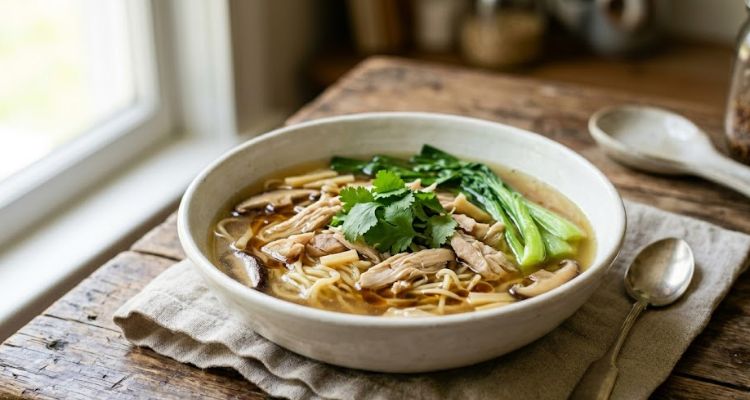

Gordon Ramsay’s chicken noodle soup is an Asian-style broth made with chicken thighs, dried shiitake mushrooms, ginger, star anise, and Shaoxing rice wine, served over egg noodles with choi sum and a drizzle of sesame oil. It takes about 30 minutes from start to bowl.
This recipe appears as “Chicken and Shiitake Noodle Soup” in Gordon Ramsay’s Quick and Delicious, where he writes that “the broths for these soups are usually laboured over for many hours to give them an intense depth of flavour, but this soup uses dried shiitake mushrooms to shortcut the process.” He calls them “really rich in umami, bringing a wonderful savouriness and depth to the dish in no time at all.”
The technique that makes this work: he poaches the chicken thighs and dried shiitake mushrooms together in the same broth from the start. The mushrooms rehydrate directly into the stock, so every drop of their umami goes into the liquid instead of getting poured down the drain in a separate soaking bowl.
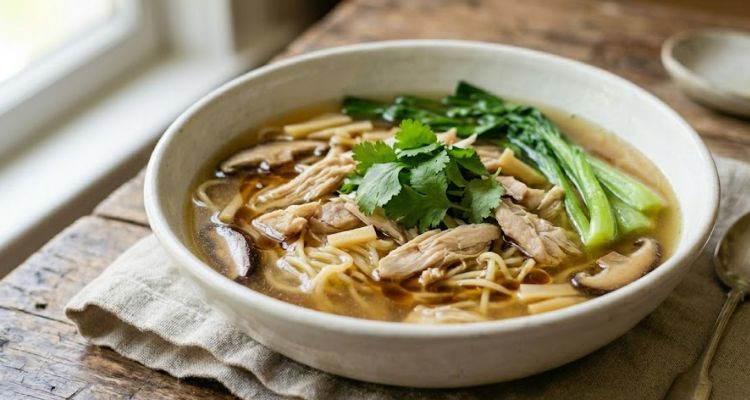
Gordon Ramsay Chicken Noodle Soup Recipe
Course: SoupsCuisine: British, AmericanDifficulty: Easy4
10
minutes20
260
kcal30
An umami-rich Asian broth from Gordon Ramsay’s Quick and Delicious, built in a single pot by poaching chicken thighs alongside dried shiitake mushrooms, star anise, and ginger. The noodles are cooked separately and rinsed cold so they don’t turn starchy in the broth.
Ingredients
6 1/3 cups (1.5 litres) chicken stock
4 chicken thighs, skin on
12 dried shiitake mushrooms
1 inch (2 to 3cm) piece of fresh root ginger, peeled and julienned
1 star anise
2 spring onions (scallions), trimmed and cut in half
7 tbsp (100ml) Shaoxing rice wine
6 1/3 oz (180g) egg noodles
2 tbsp soy sauce
7 oz (200g) choi sum
Sea salt and ground white pepper
- To serve:
2 3/4 oz (80g) bamboo shoots
Asian microherbs or cilantro (coriander) leaves
2 tsp sesame oil
Directions
- Build the broth: Place a saucepan over high heat. Pour in the chicken stock, then add the chicken thighs and dried shiitake mushrooms. Add the ginger, star anise, spring onions, and Shaoxing rice wine. Season with a big pinch of sea salt and a small pinch of white pepper.
- Simmer and skim: Bring the soup to the boil, skimming off any impurities that rise to the surface. Once boiling, reduce the heat to a strong simmer and cook for 10 minutes.
- Cook the noodles separately: Meanwhile, bring a kettle of water to the boil. Pour into a clean saucepan over high heat and season with salt. Add the noodles and cook for 3 to 4 minutes, or until just tender. Drain the noodles and hold them under running cold water until cool. Drain again and set aside. Rinsing stops the noodles from cooking further and washes off the surface starch so they don’t clump together or cloud the broth.
- Check the chicken: Remove a chicken thigh from the broth and pierce the thickest part with the tip of a sharp knife. The juices should run clear with no pinkness. If cooked, remove all the chicken pieces and the mushrooms from the broth and set aside.
- Finish the broth: Using a slotted spoon, remove the star anise, ginger, and spring onions from the broth and return it to high heat. Add the soy sauce and taste for seasoning.
- Add the greens: Roughly chop the choi sum into 3 inch (7cm) lengths and separate the stalks from the leafy parts. Add the stalks to the saucepan first and cook for 2 minutes, then add the leaves and turn the heat off. The stalks need a head start because they’re denser than the leaves.
- Shred the chicken: Remove the skin from the chicken thighs and shred the meat, discarding the bones.
- Assemble the bowls: Divide the noodles between four bowls. Top with the shiitake mushrooms, shredded chicken, and choi sum, then ladle over the hot broth. Garnish with bamboo shoots and microherbs, and finish with a drizzle of sesame oil.
FAQs
Why does Ramsay use dried shiitake mushrooms instead of fresh?
Dried shiitake mushrooms have a far more concentrated flavour than fresh ones because the drying process breaks down proteins into glutamate, which is the compound responsible for umami. When they rehydrate in the hot broth, all of that concentrated savouriness goes directly into the liquid.
Fresh shiitakes would add texture but not nearly the same depth to the stock. Ramsay specifically calls dried shiitakes a “shortcut” that replaces the hours of simmering you’d normally need to build that kind of richness. Twelve mushrooms in 1.5 litres of stock is a generous ratio, and the mushrooms themselves become part of the finished bowl rather than being discarded.
Why poach with the skin on if he removes it later?
Ramsay poaches the chicken thighs skin-on during cooking, then removes the skin before shredding. The skin renders fat into the broth as it simmers, which adds body and richness to the liquid.
Removing it before serving keeps the texture clean because poached chicken skin turns flabby and unappetising. You get the flavour contribution without the soggy skin sitting in your bowl. Thighs also stay juicier than breasts during poaching because their higher fat content protects them from drying out in just 10 minutes of simmering.
Why cook the noodles in a separate pan?
Cooking noodles directly in the broth is the biggest mistake people make with noodle soups. The starch that leaches out of the noodles turns the clear broth cloudy and slightly gluey.
Ramsay cooks the egg noodles in a separate pan of salted boiling water, then rinses them under cold running water. This washes off the surface starch and stops the cooking so the noodles hold their texture in the hot broth instead of going mushy. The noodles sit in the bowl first, and the broth goes over them at the very end. If you enjoy Ramsay’s approach to Asian-style broths, his butternut squash soup uses a similar spice-infused stock method with cumin and ginger.
How is this different from his MasterClass version?
In Gordon Ramsay Teaches Cooking II, he takes a more restaurant-level approach using leftover Szechuan-roasted chicken and building the broth from the roasting juices. He swaps egg noodles for udon, uses rice wine vinegar for tannins, and adds soy sauce for “seasoning and colour” instead of salt.
The biggest difference is timing. The MasterClass version is designed to be made days ahead. Ramsay says he’ll “make this broth, leave all those ingredients in there, chill it, refrigerate it, and then bring it up to a boil slowly three or four days later, and those aromatics are breathtaking.” The Quick and Delicious version delivers everything in 30 minutes with no leftovers required.
Why does he add the choi sum stalks before the leaves?
The stalks and leaves of choi sum have completely different densities, so they cook at different speeds. Dropping everything in at once means either the stalks are crunchy and raw or the leaves are overcooked and slimy.
Ramsay adds the stalks first and gives them a 2-minute head start, then adds the leaves and immediately turns off the heat. The residual heat wilts the leaves gently while the stalks finish softening. His MasterClass teaching reinforces this: he advises cooking vegetables to “80% done” because “they’ll finish cooking in the hot broth.” This two-stage approach applies to any greens you might substitute, like bok choy or Chinese broccoli. For another of Ramsay’s soups where vegetable timing matters, his pumpkin soup uses a similar staged addition with aromatics.
Can the broth be made ahead of time?
Yes, and Ramsay actively recommends it. In his MasterClass he explains that the broth improves when stored in the fridge for up to four days with the aromatics left in, because the flavours continue to develop as it sits.
Make the broth through step 5, leave the ginger, star anise, and spring onions in, and refrigerate once cooled. When you’re ready to eat, slowly bring it back to a boil, strain out the aromatics, then cook the noodles and greens fresh. The chicken can be poached and shredded ahead too, stored separately in the fridge. Just don’t cook the noodles until serving because they absorb liquid and lose their texture overnight.

Zaytouna Studio Team is the kitchen team behind Chef Ramsay Recipes. We cook Gordon Ramsay’s recipes from his cookbooks and videos in a home kitchen and write them up for yours, with US and metric measurements.