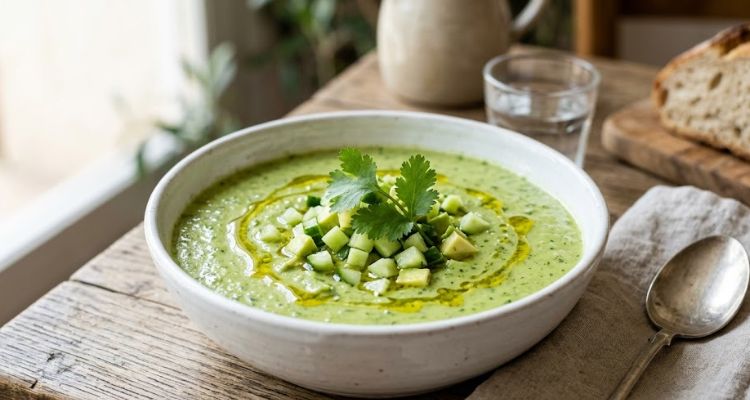

Gordon Ramsay’s avocado gazpacho is a chilled no-cook soup made with ripe avocados, cucumber, green pepper, garlic, and sherry vinegar, blended until silky and served ice cold. It comes together in about 15 minutes, then chills for at least an hour before serving.
This recipe is adapted from techniques across three of Ramsay’s cookbooks. His gazpacho method in Ultimate Home Cooking provides the no-cook base and sherry vinegar backbone, while his Chilled Leek and Avocado Soup in Healthy Appetite shows how he uses avocado for body and lemon juice to keep the colour bright. He notes in Ultimate Home Cooking that “flavours are more muted when chilled,” so seasoning generously before the soup goes into the fridge is essential.
The technique that holds this together: instead of using stale bread for body like a traditional gazpacho, the avocado does that job naturally. It gives the soup a creamy richness without any dairy, which means the clean flavours of cucumber, lime, and sherry vinegar stay sharp and bright on the palate.
Gordon Ramsay Avocado Gazpacho Recipe
Course: SoupsCuisine: British, AmericanDifficulty: Easy4
15
minutes237
1
hour30
A chilled avocado soup adapted from Gordon Ramsay’s gazpacho method in Ultimate Home Cooking and his avocado soup technique in Healthy Appetite. The avocado replaces bread as the thickener, giving it a velvety body while keeping the whole thing dairy-free and no-cook.
Ingredients
3 ripe avocados, halved, stones removed, flesh scooped out
1 cucumber, peeled and roughly chopped
1 green pepper (bell pepper), deseeded and roughly chopped
2 spring onions (scallions), trimmed and finely chopped
2 garlic cloves, peeled and crushed
Juice of 1 lime
1 1/2 to 2 tbsp sherry vinegar, or to taste
1 1/4 cups (300ml) cold vegetable stock
Extra virgin olive oil
Small bunch of fresh cilantro (coriander)
Sea salt and freshly ground black pepper
- To garnish:
1/4 cucumber, finely diced
1 small ripe avocado, finely diced
Extra virgin olive oil, for drizzling
A few cilantro (coriander) leaves
Pinch of cayenne pepper
Directions
- Blend the base: Place the avocado flesh, cucumber, green pepper, spring onions, garlic, lime juice, and sherry vinegar into a blender. Add the vegetable stock and a couple of tablespoons of extra virgin olive oil. Season generously with salt and pepper, then blend until completely smooth. Taste and adjust the seasoning, remembering that chilling will mute the flavours so it should taste slightly over-seasoned at this stage.
- Check the consistency: The soup should be pourable but creamy. If it’s too thick, add a splash more stock or cold water. If it needs more richness, add another glug of olive oil. Stir in a few torn cilantro (coriander) leaves, then cover the surface directly with cling film to prevent browning and chill for at least 1 to 2 hours until very cold.
- Prepare the garnish: Just before serving, dice the cucumber and avocado finely. Toss the diced avocado in a squeeze of lime juice to stop it browning.
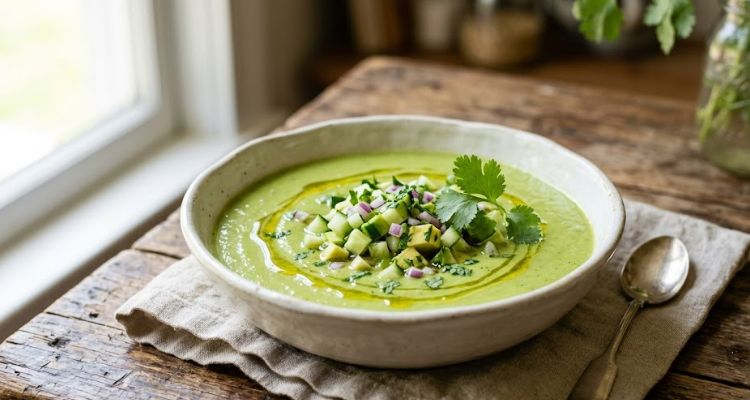
- Serve ice cold: Stir the gazpacho and taste again, adjusting the salt, pepper, or vinegar as needed. Pour into chilled bowls. Top with the diced cucumber and avocado, a drizzle of extra virgin olive oil, a few cilantro (coriander) leaves, and a light pinch of cayenne pepper.
FAQs
Why is this recipe adapted rather than taken directly from one book?
Ramsay doesn’t publish a standalone avocado gazpacho in any of his 20 cookbooks. What he does have is a gazpacho method in Ultimate Home Cooking that uses raw vegetables blended with sherry vinegar and olive oil, and a Chilled Leek and Avocado Soup in Healthy Appetite that shows how he handles avocado in cold soups.
This recipe combines both approaches honestly. The no-cook gazpacho format comes from the first, and the avocado-as-thickener idea comes from the second. Every technique traces back to something Ramsay actually does in print.
Why use sherry vinegar instead of lime juice alone?
Ramsay’s gazpacho in Ultimate Home Cooking relies on sherry vinegar as the primary acid because it has a rounder, slightly sweet sharpness that balances raw vegetables better than citrus alone. He says the secret is “getting the right balance of olive oil, sherry vinegar and seasoning.”
Lime juice goes in as well here because it does two jobs: it brightens the avocado flavour and slows the browning. But the sherry vinegar is what gives the soup backbone. Without it the whole thing tastes flat and green rather than lively. If you enjoy Ramsay’s approach to cold soups, his roasted tomato soup uses the same vinegar-balancing principle with balsamic instead.
Why does avocado replace stale bread in this version?
In his traditional gazpacho, Ramsay adds 75g of stale crusty white bread to thicken the soup and give it body. The bread soaks up the tomato juices during marinating and blends into a creamy texture.
Avocado does the same job naturally because of its high fat content and smooth texture. It gives the gazpacho a rich mouthfeel without any dairy or gluten. The trade-off is that bread-thickened gazpacho keeps for days while avocado gazpacho starts to brown after 24 hours, so this one is best made the day you plan to serve it.
Why season more heavily before chilling?
Ramsay makes this point in Ultimate Home Cooking when he writes that “flavours are more muted when chilled.” Cold temperatures dull your taste buds, so a soup that tastes perfectly seasoned at room temperature will taste flat straight from the fridge.
His gazpacho method has you taste and adjust twice: once after blending, and once again just before serving. The same logic applies here. Season the base until it tastes slightly too salty and too sharp at room temperature, because an hour in the fridge will pull everything back into balance. If you’re still not sure, serve a small spoonful first and adjust from there.
How does Ramsay keep cold soups chilled at the table?
In Ultimate Home Cooking he includes a tip box called “How to Keep Gazpacho Chilled” where he freezes small portions of the gazpacho itself in ice cube trays. You drop these into the bowls just before serving, so the soup stays cold without getting watered down the way regular ice cubes would.
This trick works perfectly with avocado gazpacho. Freeze a cup of the blended soup in an ice cube tray before chilling the rest. When you’re ready to serve, add one or two gazpacho cubes to each bowl. They melt slowly and keep the temperature down while adding more flavour instead of diluting it. For another of his chilled soup techniques, his butternut squash soup can also be served at room temperature in warmer months.
Why press cling film directly onto the surface?
Avocado browns quickly when exposed to air because of an enzyme called polyphenol oxidase that reacts with oxygen. Ramsay uses lemon juice in his Healthy Appetite avocado soup to slow this down, and lime juice does the same thing here.
But acid alone won’t stop browning during a two-hour chill. Pressing cling film directly onto the surface of the soup creates a seal that blocks oxygen contact entirely. This is the same technique used for guacamole and avocado-based sauces. When you peel the film off before serving, the gazpacho underneath should still be bright green.

Zaytouna Studio Team is the kitchen team behind Chef Ramsay Recipes. We cook Gordon Ramsay’s recipes from his cookbooks and videos in a home kitchen and write them up for yours, with US and metric measurements.