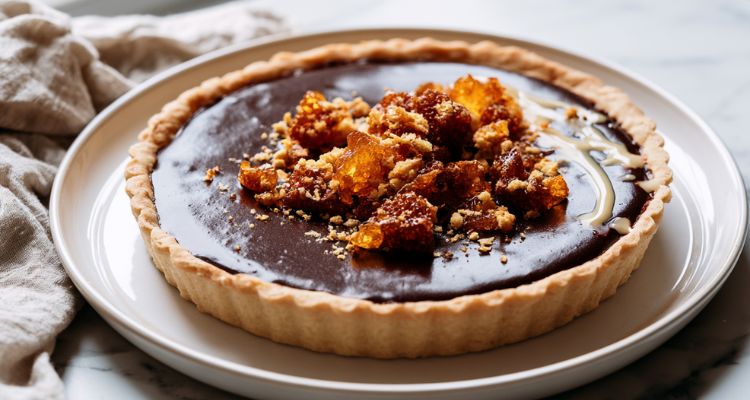

This Gordon Ramsay chocolate tart recipe is a rich, silky dark chocolate ganache baked inside crisp homemade sweet pastry, using just five filling ingredients. It takes about 2 1/2 hours from start to plate, though most of that is hands-off chilling and baking.
The recipe comes from Gordon Ramsay: Bread Street Kitchen, where he writes that “as there are very few ingredients for the filling, always use a good-quality dark chocolate with at least 70% cocoa solids; the flavour of the finished tarts depends on it.” He serves it with honeycomb pieces and raspberry sorbet at the restaurant.
The technique that sets this apart: he uses a stick blender to emulsify the filling instead of whisking. Whisking traps air bubbles that crack the surface during baking, so keeping the blender blades fully submerged creates a glossy, perfectly smooth ganache with zero bubbles.
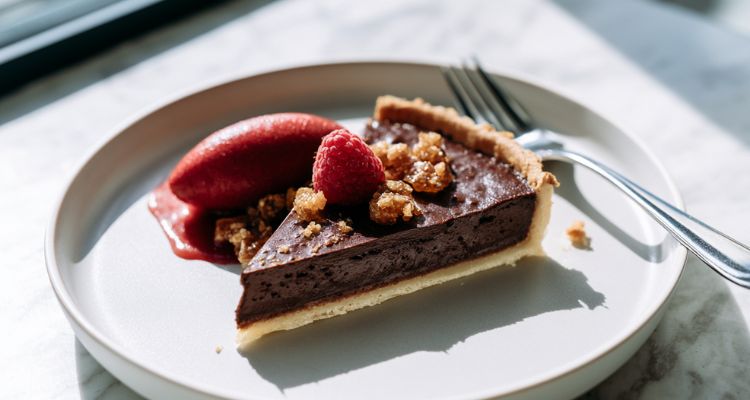
Gordon Ramsay Chocolate Tart Recipe
Course: DessertsCuisine: BritishDifficulty: Easy8
30
minutes1
10
minutes520
A dark chocolate ganache tart baked low and slow until set to a dense, truffle-like finish. From Gordon Ramsay’s Bread Street Kitchen, using homemade sweet pastry and 70% dark chocolate.
Ingredients
- For the sweet pastry:
1/2 cup plus 1 tbsp (125g) butter, softened
2/3 cup (75g) powdered sugar (icing sugar), sifted
2 large eggs, beaten separately
2 cups (250g) all-purpose flour (plain flour), plus extra for dusting
Pinch of sea salt
- For the filling:
10 1/2 oz (300g) dark chocolate (about 70% cocoa solids), very finely chopped
1/3 cup plus 1 tbsp (100ml) whole milk
3/4 cup plus 1 tbsp (200ml) heavy cream (double cream)
2 large eggs, beaten
- To serve (optional):
Pouring cream
Honeycomb pieces or crushed honeycomb
Raspberry sorbet
Directions
- Make the pastry. Cream the butter and sugar together in a bowl until light. Beat in one of the beaten eggs. Stir in the flour and salt a third at a time, bringing it together into a very soft dough. Work it briefly into a ball with your hands but don’t overhandle it. Pat flat, wrap in cling film, and chill for at least 1 hour. If it still feels soft after that, give it more time.
- Line the tin. Roll the pastry out on a lightly floured surface to about 3mm thick. Line a 24cm (9.5-inch) fluted loose-based tart tin, leaving some pastry overhanging the rim. Reserve leftover pastry for patching. Prick the base all over with a fork, then chill for 30 minutes.
- Blind bake the case. Preheat the oven to 400°F (200°C / 180°C fan). Place the tin on a baking sheet, line the pastry with parchment and fill with baking beans or uncooked rice. Bake for 10 to 12 minutes. Remove the beans and parchment, patch any cracks with reserved raw pastry, then brush all over with the remaining beaten egg. Return to the oven for 5 minutes until cooked and pale golden.
- Trim and cool. While the case is still warm, use a sharp knife to trim the excess pastry level with the rim. Brush out any loose crumbs from inside. Leave to cool completely in the tin. Reduce the oven to 250°F (120°C). Don’t use the fan setting.
- Make the filling. Put the chopped chocolate in a large heatproof bowl. Pour the milk and cream into a small saucepan and bring gently to the boil, then pour straight over the chocolate. Let it sit for a few minutes to melt, then stir very gently until smooth. You don’t want to create air bubbles here. Fold in the beaten eggs, then blend with a stick blender for a minute or two until smooth and glossy. Keep the blades fully submerged the entire time to avoid trapping air.
- Bake the tart. Place the tart case (still in its tin) on the baking sheet. Pour in the chocolate mixture, filling the case as high as you dare. Use a chef’s blowtorch to pop any surface bubbles, or a cocktail stick if you don’t have one. Carefully transfer to the oven and bake for about 50 minutes until the filling is just set and smooth on the surface.
- Cool and serve. Leave the tart to cool and set completely before removing from the tin. Serve with pouring cream, honeycomb pieces, and raspberry sorbet if you like.
FAQs
Why does Ramsay use a stick blender instead of whisking the filling?
Whisking a chocolate ganache introduces air bubbles, and those bubbles expand in the oven and crack the surface. The whole point of baking this tart at such a low temperature is to get a perfectly smooth, glossy top.
A stick blender emulsifies the chocolate, cream, and eggs together without whipping air in, as long as you keep the blades fully submerged. The result is a filling that’s dense and truffle-like rather than mousse-like. If you’ve ever had a chocolate tart with a cracked or pockmarked surface, air bubbles were probably the reason.
Why does he bake at such a low temperature?
The filling bakes at just 250°F (120°C), which is unusually low even for custard-based desserts. At higher temperatures, the eggs in the ganache set too fast around the edges while the centre stays liquid, which causes cracking.
His Passion for Flavour cookbook takes this even further. That version bakes at 250°F (130°C) for 25 minutes, then he turns the oven off completely and leaves the tart inside for another 30 minutes. Both approaches aim for the same thing: a filling that sets from residual heat rather than direct cooking, so it stays silky all the way through.
Why 70% cocoa solids and not something milder?
Ramsay is specific about this in the Bread Street Kitchen recipe. With only four filling ingredients (chocolate, milk, cream, eggs), the chocolate does all the flavour work. A 50% or 55% bar would taste too sweet and one-dimensional because there isn’t enough sugar in the recipe to balance a milder chocolate.
That said, he includes a tip for people who find 70% too bitter: add 1 to 2 tablespoons of caster sugar to the milk and cream before heating. This softens the edge without changing the texture. If you enjoy chocolate mousse or chocolate semifreddo, you’ll already know how much cocoa percentage affects the final result.
What makes the pastry different from a standard shortcrust?
This is a sweet enriched pastry, not a regular shortcrust. It uses powdered sugar instead of granulated, which dissolves into the butter during creaming and creates a finer, more biscuit-like texture when baked. The egg adds richness and helps bind the dough without making it tough.
The key instruction Ramsay gives is “do not overhandle.” Sweet pastry has a higher fat and sugar ratio than shortcrust, so it softens quickly from the heat of your hands. That’s why the recipe calls for two separate chilling stages: one hour after mixing and another 30 minutes after lining the tin. Skipping either one means the pastry will shrink during blind baking.
Can I make individual tarts instead of one large one?
The original Bread Street Kitchen recipe actually makes 8 individual tarts using 9.5cm (4-inch) fluted tins. If you go that route, cut the blind baking time to 10 to 12 minutes and bake the filled tarts for 30 to 35 minutes instead of 50. Everything else stays the same.
Individual tarts are easier to serve and look more polished on the plate, which is probably why it’s the restaurant default. If you’re making dessert for a dinner party alongside something like panna cotta or a chocolate lava cake, individual portions let people pick.
How should I store leftover chocolate tart?
This tart keeps well in the fridge for 2 to 3 days, covered loosely. The ganache filling actually improves overnight because it firms up to a denser, more truffle-like consistency. Bring it back to room temperature for about 20 minutes before serving so the chocolate softens enough to taste properly.
Don’t freeze it. The pastry goes soggy when it thaws and the ganache can develop a grainy texture from ice crystals. If you want a make-ahead option, bake the pastry case a day early and store it in an airtight container at room temperature, then make and pour the filling on the day you’re serving.
Zaytouna Studio Team is the kitchen team behind Chef Ramsay Recipes. We cook Gordon Ramsay’s recipes from his cookbooks and videos in a home kitchen and write them up for yours, with US and metric measurements.