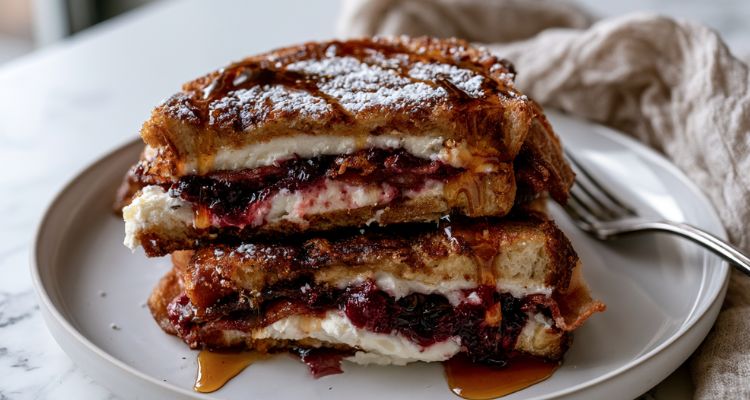

Gordon Ramsay’s Michigan french toast sandwich pairs custard-soaked brioche with a warm tart cherry compote, whipped cream cheese, and crispy maple-glazed bacon. It takes about 25 minutes and turns breakfast into something worth getting out of bed for.
This recipe is adapted from Ramsay’s french toast techniques across three cookbooks: Gordon Ramsay’s Home Cooking, Ramsay in 10, and Gordon Ramsay’s Secrets. No exact “Michigan French Toast Sandwich” appears in his published books, so this version combines his methods with Michigan’s signature tart cherries and real maple syrup to create a sandwich that fits right into the comfort food tradition he explored in the state’s Upper Peninsula.
The technique that holds this together: his 30-second soak. In Home Cooking, Ramsay is specific that bread “only needs a brief soak, so it doesn’t become too soggy and fall apart.” That restraint matters even more in a sandwich because the bread has to support fillings without collapsing on the plate.
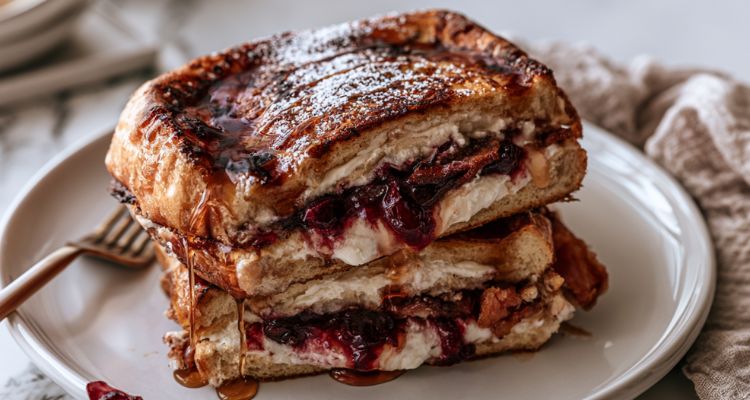
Gordon Ramsay Michigan French Toast Sandwich
Course: BreakfastCuisine: BritishDifficulty: Easy4
10
minutes15
890
kcalCustard-soaked brioche filled with tart cherry compote and cream cheese, then pan-fried using Ramsay’s butter-and-oil method from Gordon Ramsay’s Home Cooking. The bacon technique, pressing rashers flat between two baking trays, comes from the same book. Michigan tart cherries and maple syrup are the regional additions that make this version distinct.
Ingredients
- For the french toast:
8 thick slices brioche loaf (day-old works best)
2/3 cup (150ml) whole milk
3 large eggs
1 tsp vanilla extract
1/4 tsp sea salt
1 tbsp demerara (cane) sugar
1/2 tsp butter per batch
1 tsp vegetable oil per batch
- For the tart cherry compote:
1 1/2 cups (200g) frozen or fresh tart cherries, pitted
2 tbsp real maple syrup
1 tsp lemon juice
Pinch of ground cinnamon
- For the filling and topping:
8 rashers smoked streaky bacon
4 oz (115g) cream cheese, softened
1 tbsp powdered (icing) sugar
Real maple syrup, for drizzling
Directions
- Press the bacon flat: Preheat the oven to 375F (190C). Lay the bacon rashers on a baking tray, then place a second baking tray directly on top to press them flat. Cook for 15 to 20 minutes until completely crisp. This two-tray method is how Ramsay gets bacon “so flat and crispy in the restaurant,” as he explains in Home Cooking. It only works with streaky bacon because the slices are thin enough and have more fat running through them. Drain on kitchen paper when done.
- Make the cherry compote: While the bacon cooks, combine the tart cherries, maple syrup, lemon juice, and cinnamon in a small saucepan over medium heat. Cook for 5 to 7 minutes, stirring occasionally, until the cherries break down and the liquid thickens into a loose jam. Take it off the heat and set aside.
- Whip the cream cheese: Beat the softened cream cheese with the powdered sugar until smooth and spreadable. Set aside at room temperature so it spreads easily on warm bread.
- Soak the brioche: Lightly whisk the milk, eggs, vanilla, and salt in a wide shallow bowl. Ramsay is clear about this: don’t over-beat. Dip each brioche slice for 30 seconds per side, turning once. The bread only needs a brief soak so it doesn’t become too soggy and fall apart.
- Pan-fry in butter and oil: Heat the butter and oil in a large non-stick frying pan (skillet) over medium heat until the butter melts and stops foaming. Add two soaked slices and cook for 1 to 2 minutes per side until golden brown. For the caramelized crust, sprinkle a pinch of demerara sugar on top of each slice before flipping, so it melts directly onto the hot pan. This technique comes from Ramsay in 10 and gives a crunch that plain frying doesn’t. Repeat with remaining slices, adding a little more butter and oil each batch.
- Build the sandwich: Spread cream cheese on one slice of french toast. Spoon warm cherry compote over it. Lay two rashers of pressed bacon on top, drizzle with maple syrup, and close with the second slice. Serve immediately while the bread is still crisp on the outside.
FAQs
Why does Ramsay soak bread for only 30 seconds instead of letting it sit?
Most french toast recipes tell you to soak bread until it’s saturated all the way through. Ramsay takes the opposite approach in Home Cooking, keeping it to 30 seconds per side so the outside absorbs the custard while the center stays firm.
This matters even more in a sandwich. If the bread is soaked through, it can’t support the weight of compote, cream cheese, and bacon without falling apart in your hands. The brief soak gives you enough eggy flavour on the surface while keeping structural integrity underneath.
Why use butter and oil together instead of just butter?
Ramsay uses this combination across all three of his french toast recipes. Butter gives flavour, but it burns at a lower temperature than oil does.
Mixing the two lets you cook at a higher heat without the butter smoking and turning bitter. In his pain perdu recipe from Gordon Ramsay’s Secrets, he heats the butter until it “stops foaming” before adding the bread, which is the visual cue that the water has cooked out and the fat is ready. That’s when you get the cleanest golden colour.
Why press bacon between two baking trays?
This is a restaurant technique Ramsay shares in Home Cooking. The weight of the second tray keeps the bacon perfectly flat as it renders, so every part of the rasher makes contact with the hot surface.
You get evenly crisp bacon from edge to edge instead of wavy strips that are burnt in some spots and chewy in others. Ramsay notes this only works with streaky bacon because it’s thinly sliced with more fat running through it. Back bacon is too thick and lean for this method.
Why tart cherries instead of sweet cherries?
Michigan produces about 75% of the tart cherries grown in the United States, so they’re the natural choice for a Michigan-inspired dish. But there’s a cooking reason too: tart cherries break down faster and release more pectin, which means the compote thickens naturally without adding cornstarch.
Sweet cherries hold their shape better, which is great for eating fresh but doesn’t give you the jammy, spreadable consistency you want inside a sandwich. The tartness also cuts through the richness of the cream cheese and maple syrup, so the whole thing doesn’t taste one-dimensionally sweet. If you enjoy fruit-forward breakfast dishes, Ramsay takes a similar approach with pan-roasted peaches on brioche in Gordon Ramsay’s Secrets.
How is this different from Ramsay’s other french toast recipes?
Ramsay has three distinct french toast approaches across his books. The Home Cooking version is the simplest: white bread, eggs and milk, served open-faced with bacon or berries. His Ramsay in 10 version goes in a dessert direction, stuffing croissants with custard and topping them with butterscotch apples and sesame brittle. The pain perdu from Gordon Ramsay’s Secrets uses brioche with pan-roasted peaches and mascarpone.
This Michigan adaptation borrows the best technique from each: the soak timing and bacon method from Home Cooking, the sugar-caramelization flip from Ramsay in 10, and the brioche choice from Secrets. The sandwich format and Michigan ingredients are the additions that make it a different dish entirely. For another Ramsay breakfast to pair with it, his scrambled eggs take about 3 minutes and work well on the side.
Can day-old brioche really make better french toast?
Ramsay says exactly this in Ramsay in 10 about his croissant french toast: “it is even better with slightly stale croissants.” The same principle applies to brioche.
Fresh bread has more moisture in it, so when you soak it in custard, it absorbs too much too fast and turns mushy. Day-old bread has dried out slightly, which means it absorbs the custard more evenly and holds together better in the pan. If your brioche is fresh, slice it and leave the slices uncovered on a wire rack for a few hours before making this.

Zaytouna Studio Team is the kitchen team behind Chef Ramsay Recipes. We cook Gordon Ramsay’s recipes from his cookbooks and videos in a home kitchen and write them up for yours, with US and metric measurements.