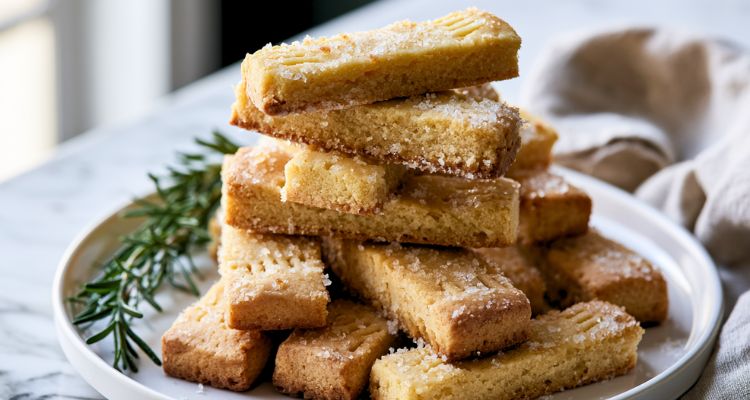

Gordon Ramsay’s shortbread cookies are made with four ingredients: flour, butter, sugar, and a pinch of sea salt. They bake in 30 minutes at 340F (170C) and make 24 crisp, crumbly fingers that keep for up to five days.
The recipe appears in Gordon Ramsay’s Bread Street Kitchen as “Rosemary Shortbread,” where he calls it “a foolproof base” you can customise with herbs, citrus zest, or leave completely plain. He suggests lemon thyme, fennel seeds, and dried lavender as variations.
The technique that sets his version apart: he rubs cold butter into flour by hand instead of creaming it with sugar first. This creates a sandier, more crumbly texture because the fat coats the flour particles before gluten can develop, which is why his shortbread snaps cleanly instead of bending.
Gordon Ramsay Shortbread Cookies Recipe
Course: DessertsCuisine: BritishDifficulty: Easy24
10
minutes30
80
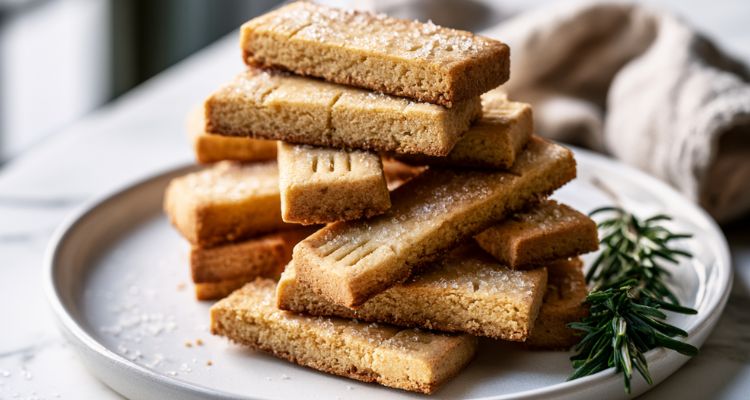
kcalA four-ingredient shortbread from Gordon Ramsay’s Bread Street Kitchen, shaped into 24 slim fingers, pricked with a fork, and baked low and slow until just golden. His Ultimate Cookery Course version uses a creaming method for a slightly softer bite.
Ingredients
- Shortbread dough
1¾ cups (225g) all-purpose flour (plain flour), plus extra for dusting
Pinch of sea salt
⅓ cup (75g) superfine sugar (caster sugar), plus extra for sprinkling
⅔ cup (150g) unsalted butter, at room temperature, cubed, plus extra for greasing
- Optional flavouring (choose one)
1 small rosemary sprig, leaves picked and finely chopped
finely grated lemon or orange zest, lemon thyme, fennel seeds, or dried edible lavender
Directions
- Prep the oven and tray: Preheat to 340F (170C / 150C fan / Gas 3). Grease a baking sheet with butter.
- Build the dough: Sift the flour and salt into a large bowl, then stir in the sugar. Rub in the cubed butter using your fingertips until the mixture resembles fine breadcrumbs. If adding a flavouring, stir it in now. Knead and squeeze the mixture together with warm hands until it’s well combined and smooth, with no wrinkles or cracks.
- Shape the fingers: Cut the dough in half. Roll out one half on a lightly floured surface to a 5 x 5 inch (12 x 12cm) square, about ½ inch (1cm) thick. Cut into ¾ inch (2cm) slices, then cut each slice in half through the middle to make 12 fingers. Prick all over with a fork and transfer to the prepared baking sheet. Repeat with the other piece of dough to make 24 fingers total.
- Bake low and slow: Bake for about 30 minutes, until the shortbread is golden and looks a little risen and spongy. Don’t wait for deep colour: shortbread firms up as it cools, so pulling them slightly underdone is better than overbaking.
- Finish and cool: Remove from the oven and sprinkle with caster sugar while still warm, if you like. Leave to cool completely on the baking sheet before moving. Store in an airtight container for up to 5 days.
FAQs
Why does Ramsay rub in butter instead of creaming it?
Most cookie recipes start by beating butter and sugar together, which traps air and creates a softer, chewier texture. Ramsay’s rub-in method does the opposite: it coats each flour particle in fat before any liquid can activate gluten. The result is a drier, sandier crumb that snaps when you bite instead of bending.
Why does he bake shortbread at such a low temperature?
At 340F (170C), the butter melts slowly and the sugars barely caramelise, which keeps the colour pale and the texture even all the way through. Higher heat would brown the outside before the centre dries out, giving you a cookie that’s crisp on the edges and doughy in the middle. His instruction to look for “a little risen and spongy” is the visual cue that the moisture has baked out.
How is his Bread Street Kitchen version different from the Ultimate Cookery Course one?
The Ultimate Cookery Course shortbread uses a creaming method: beat butter and sugar until smooth, then add flour on low speed. That version bakes hotter at 350F (180C) for just 15 to 20 minutes and makes a slightly softer, more delicate biscuit. The Bread Street Kitchen version bakes lower and longer, producing a firmer snap and a drier crumb that holds up better in a biscuit tin.
Why does he prick the dough with a fork?
Pricking creates tiny holes that let steam escape during baking. Without them, trapped moisture puffs the dough up unevenly, and you get shortbread that’s spongy in patches and flat in others. It also gives the fingers that classic dotted pattern on top.
Can you make these as round cookies instead of fingers?
Ramsay shapes fingers because they bake more evenly than thick rounds, but his Ultimate Cookery Course version offers rounds as an alternative: roll to ¼ inch (5-7mm) thick and stamp out with a 2½ inch (6cm) cutter. If you prefer that shape, his sugar cookie technique covers how to cut and chill shapes so they hold in the oven.

Zaytouna Studio Team is the kitchen team behind Chef Ramsay Recipes. We cook Gordon Ramsay’s recipes from his cookbooks and videos in a home kitchen and write them up for yours, with US and metric measurements.