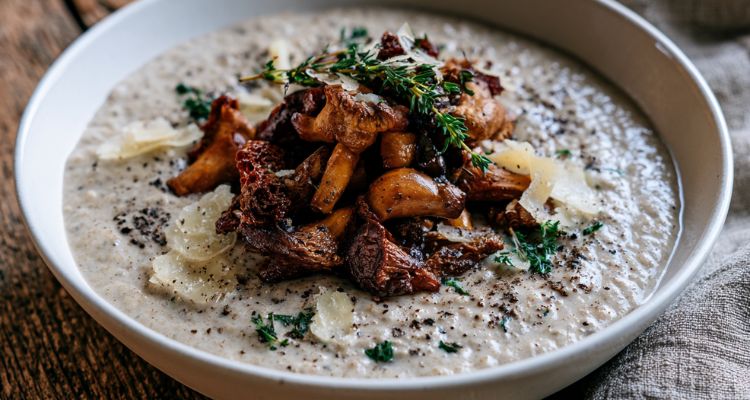

Gordon Ramsay’s mushroom soup is a rich, silky bowl made with dried porcini mushrooms, shallots, white wine, chicken stock, and double cream, blended and strained for a velvety finish, then topped with butter-fried wild mushrooms. It takes about 40 minutes from start to bowl.
This recipe is adapted from the Mushroom Velouté in Gordon Ramsay’s Secrets, where he builds intense mushroom flavour by soaking dried mushrooms, reducing the soaking liquor with white wine and stock, then finishing with cream and straining through a sieve. His wild mushroom garnish technique from Ultimate Christmas and his umami approach from Quick and Delicious, where he writes that mushrooms are how “chefs often look to recreate the depth of flavour that meat brings to cooking,” round out the method.
The technique that makes this work: he reduces the liquid twice. First the wine reduces by half with the mushrooms, concentrating the flavour. Then the stock and mushroom liquor go in and reduce by half again. By the time the cream hits the pan, the base is so concentrated that a small amount of dried mushrooms delivers the punch of a much larger quantity of fresh ones.
Gordon Ramsay Mushroom Soup Recipe
Course: SoupsCuisine: American, BritishDifficulty: Medium4
15
minutes25
220
kcal40
A deeply flavoured cream of mushroom soup adapted from the Mushroom Velouté in Gordon Ramsay’s Secrets, scaled up to a full soup and topped with high-heat sautéed wild mushrooms using his garnish technique from Ultimate Christmas. The double reduction builds intensity that no single-simmer soup can match.
Ingredients
- For the soup:
1 3/4 oz (50g) dried porcini mushrooms (or a mix of dried morels and ceps)
1 2/3 cups (400ml) boiling water
2 tbsp olive oil
2 shallots, peeled and finely chopped
2/3 cup (150ml) dry white wine
2 1/2 cups (600ml) chicken stock
7 tbsp (100ml) heavy cream (double cream)
Sea salt and freshly ground black pepper
- For the mushroom garnish:
1 1/2 tbsp olive oil
14 oz (400g) mixed wild mushrooms (chanterelles, trompettes, chestnut), cleaned and trimmed
Small knob of butter
Fresh thyme leaves, to serve
Parmesan shavings, to serve
Directions
- Soak the dried mushrooms: Place the dried porcini in a bowl and pour over the boiling water. Leave to soak for 10 minutes until softened, then lift out the mushrooms and chop them finely. Strain the soaking liquor through a fine sieve lined with kitchen paper to catch any grit, and reserve the liquid. This liquor is packed with flavour so don’t discard a drop of it.
- Sweat the shallots: Heat the olive oil in a large saucepan over a low heat. Add the shallots and sauté gently for about 3 minutes until softened but not coloured. Colour on the shallots would muddy the clean mushroom flavour.
- First reduction: Add the chopped soaked mushrooms and the white wine. Increase the heat and simmer until the liquid has reduced by half. The wine concentrates as it cooks down and pulls flavour out of the mushrooms at the same time.
- Second reduction: Pour in the reserved mushroom soaking liquor and the chicken stock. Bring to the boil, then reduce the heat and simmer until the liquid has reduced by half again. This stage takes about 10 to 12 minutes and is where the real depth develops.
- Add the cream: Stir in the double cream, return to a gentle simmer, and cook for another 5 minutes. Season with salt and pepper.
- Strain for silk: Pour the soup through a fine sieve into a clean pan, pressing the mushroom pulp firmly with the back of a ladle to extract as much liquid and flavour as possible. Discard the pulp. Taste and adjust the seasoning. Keep warm over a low heat.
- Fry the mushroom garnish: Heat the olive oil in a large frying pan over high heat. Add the wild mushrooms and fry for a few minutes until the moisture they release has cooked off completely and the pan is quite dry. This step is crucial because wet mushrooms steam instead of browning. Add the butter, season well, and stir, then remove from the heat.
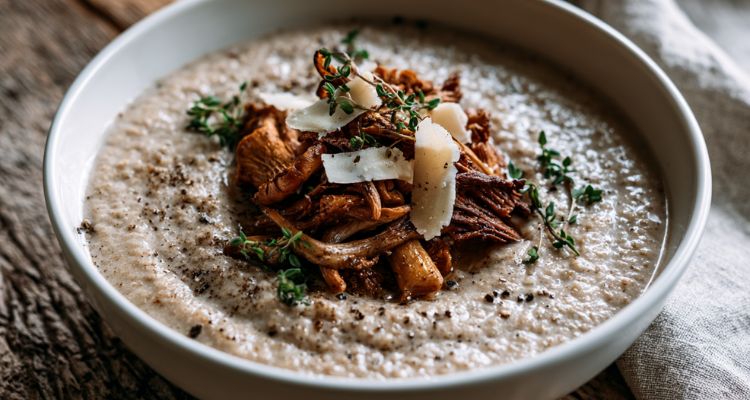
- Serve: Pour the hot soup into warmed bowls and spoon the sautéed mushrooms into the middle. Top with Parmesan shavings and a few fresh thyme leaves, and grind over some black pepper.
FAQs
Why does Ramsay use dried mushrooms instead of fresh for the soup base?
Dried mushrooms have a far more concentrated flavour than fresh because the drying process breaks down proteins into glutamate, the compound responsible for umami. Fifty grams of dried porcini delivers more depth than several times that weight in fresh mushrooms.
The soaking liquor matters just as much as the mushrooms themselves. When dried porcini rehydrate, all of that concentrated flavour leaches into the water, which becomes an intensely flavoured stock in its own right. That’s why Ramsay strains it carefully and adds it back into the soup. Fresh mushrooms sitting in the pan only give up their flavour slowly during cooking, which is why most homemade mushroom soups taste thin.
Why reduce the liquid twice instead of once?
Each reduction stage concentrates different flavours. The first reduction cooks off the alcohol in the wine while pulling flavour from the rehydrated mushrooms. What’s left behind is a thick, intensely mushroomy wine reduction.
The second reduction takes the stock and mushroom liquor down by half again, which tightens up the body and deepens the savoury notes. By the time the cream goes in, the base is so concentrated that 100ml of cream is enough to make the soup feel rich without drowning the mushroom flavour. A single simmer would need twice the cream to reach the same body, and the mushroom taste would get buried underneath it.
Why strain the soup and throw away the mushroom pulp?
After two reductions and 5 minutes of simmering in cream, the soaked mushrooms have given up everything they have. What’s left is fibrous pulp that would make the texture grainy if you blended it into the finished soup.
Ramsay presses the pulp hard with the back of a ladle to squeeze out every last drop of flavour, then discards it. The result is a completely smooth, velvety liquid with no gritty bits. The texture contrast comes from the fresh wild mushrooms spooned on top instead, which is why the garnish matters so much in this recipe. If you enjoy Ramsay’s approach to silky soups, his pumpkin soup uses a similar strain-and-press technique for a smooth finish.
Why does the mushroom garnish need a dry pan before adding butter?
Wild mushrooms are full of water. When they hit a hot pan, that water releases and pools around them. If you add butter at this stage, it mixes with the mushroom liquid and you end up steaming instead of frying.
Ramsay waits until the moisture has completely cooked off and the pan is “quite dry” before adding the butter. At that point, the mushrooms start to brown properly in the fat, which creates caramelised edges and a nutty flavour that contrasts with the smooth soup underneath. This technique from Ultimate Christmas applies to any time you cook mushrooms, whether for a soup garnish, a steak topping, or a pasta sauce.
Can different mushrooms be used for the garnish?
Ramsay uses chanterelles and trompettes in Ultimate Christmas because their shapes hold up well to high heat and they look elegant in the bowl. In Quick and Delicious, he says chestnut, Portobellini, and oyster mushrooms all work as alternatives.
The key is mixing at least two or three varieties because each brings a different texture and flavour. Chestnut mushrooms are meaty and firm, oyster mushrooms are delicate and silky, and chanterelles have a slight peppery note. A single variety looks and tastes flat by comparison. Whatever you choose, clean them with a damp cloth rather than running water, because waterlogged mushrooms won’t brown. For another Ramsay recipe where mushroom variety matters, his chicken noodle soup uses dried shiitakes for the same umami-building trick.
Why finish with Parmesan shavings on a mushroom soup?
Parmesan is one of the richest natural sources of glutamate, the same compound that makes mushrooms taste savoury. Shaving it over the top doubles down on the umami without adding another competing flavour.
Ramsay uses this combination in both Ultimate Christmas and Secrets because the salty, crystalline texture of aged Parmesan works against the smooth soup and the soft mushrooms. A few thin shavings melt slowly into the hot surface, creating little pockets of concentrated flavour in each spoonful. Grating the cheese finely would blend it in and lose that effect, so use a vegetable peeler for wide, thin shavings instead.

Zaytouna Studio Team is the kitchen team behind Chef Ramsay Recipes. We cook Gordon Ramsay’s recipes from his cookbooks and videos in a home kitchen and write them up for yours, with US and metric measurements.