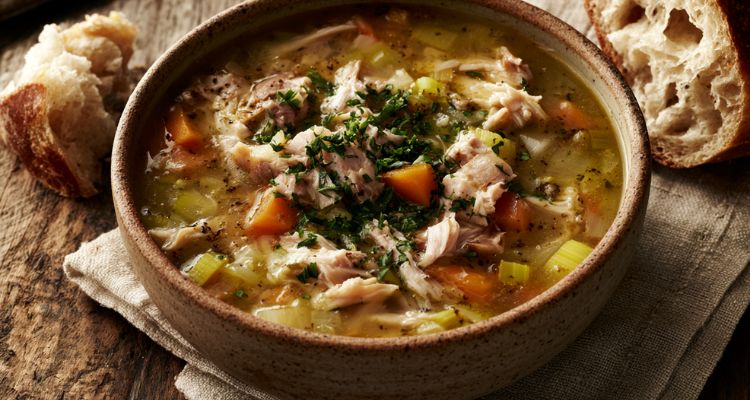

Gordon Ramsay’s turkey soup is a hearty, golden broth built from a leftover roast turkey carcass with carrots, leeks, garlic and thyme, finished with shredded turkey meat and fresh parsley. It takes about 2 hours and 30 minutes, with most of that time hands-off while the stock simmers.
This recipe is adapted from Ramsay’s roast dinner stock technique in Ultimate Home Cooking, where he writes that “the best compromise is, after a roast dinner, to put the bones and any meat still clinging to them in a large pot with a halved onion, a halved head of garlic and roughly chopped carrots, leeks and a bunch of thyme or parsley.” His books don’t include a standalone turkey soup, so this adapts his stock method and soup-building approach to leftover turkey.
The technique that sets this apart: Ramsay insists on starting with cold water and bringing it slowly to a simmer. Dropping bones into boiling water seals the surface proteins before they can release into the liquid, so you get a weaker, cloudier stock. A slow climb from cold extracts more flavour and keeps the broth clean.
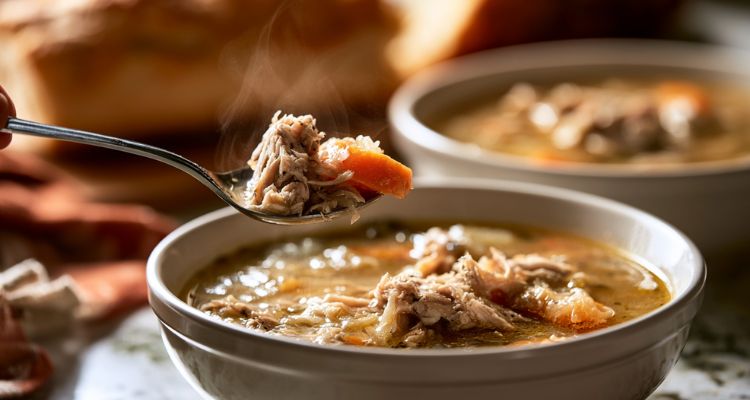
Gordon Ramsay Turkey Soup Recipe
Course: Soups6
20
minutes2
15
minutes233
2
hours35
A leftover turkey soup adapted from Gordon Ramsay’s roast dinner stock technique in Ultimate Home Cooking. No standalone turkey soup appears in his cookbooks, so this builds on his detailed method for turning a roast carcass into rich, flavourful stock, then finishes it as a chunky vegetable and turkey soup.
Ingredients
1 leftover roast turkey carcass, broken into pieces
1 large onion, peeled and halved
1 head of garlic, halved horizontally
2 carrots, peeled and roughly chopped
2 leeks, trimmed and roughly chopped
A bunch of thyme or parsley
1 tsp black peppercorns
Cold water, enough to just cover the carcass
- Soup
1 tbsp olive oil
1 medium onion, peeled and finely diced
2 carrots, peeled and diced
2 celery sticks, trimmed and diced
1 leek, trimmed, halved lengthways and sliced
2 garlic cloves, peeled and finely crushed
2 bay leaves
A few thyme sprigs
10 1/2 cups (2.5 litres) strained turkey stock (from above)
3 cups (about 400g) shredded leftover turkey meat
Sea salt and black pepper
Small bunch of flat-leaf parsley, leaves chopped
Directions
- Build the stock: Place the broken turkey carcass in a large pot with the halved onion, halved garlic head, roughly chopped carrots and leeks, thyme or parsley, and peppercorns. Pour in enough cold water to just cover everything. Bring slowly to a simmer, skimming off any scum and fatty residue that rises to the surface.
- Simmer low and slow: Once at a gentle simmer, partially cover and cook for about 2 hours. Don’t let it boil hard because that makes the stock cloudy and greasy. Top up with a little boiling water if the level drops below the bones. The stock is ready when it tastes rich and savoury on its own.
- Strain the stock: Set a fine sieve or colander lined with muslin over a clean pot. Pour the stock through, pressing the vegetables gently with the back of a ladle to extract as much liquid as possible. Discard the carcass and spent vegetables. You should have roughly 10 1/2 cups (2.5 litres) of stock.
- Cook the vegetables: Heat the olive oil in a large, clean pan over medium heat. Add the diced onion, carrots, celery, leek and crushed garlic with a pinch of salt. Cook, stirring occasionally, for 6 to 8 minutes until the vegetables soften and start to colour. Add the bay leaves and thyme sprigs.
- Bring it together: Pour in the strained turkey stock and bring to a simmer. Cook for 15 to 20 minutes until the vegetables are tender but still have a little bite. Stir in the shredded turkey meat and warm through for 3 to 4 minutes. Taste and season well with salt and pepper.
- Serve the soup: Remove the bay leaves and thyme sprigs. Ladle into warm bowls and scatter chopped parsley over the top. Serve with crusty bread on the side.
FAQs
Why isn’t there a turkey soup in Ramsay’s cookbooks?
Ramsay’s books cover roast turkey recipes in Great British Pub Food and Ultimate Christmas, but neither includes a soup made from the leftovers. His approach to leftover poultry focuses on stock-making as a building block rather than a finished dish.
In Ultimate Home Cooking, he gives a detailed method for turning any roast dinner carcass into stock and specifically mentions using “the bones and any meat still clinging to them.” This adaptation takes that stock technique and builds a complete soup around it using his standard aromatics and finishing method.
Why does Ramsay start stock with cold water instead of hot?
He’s clear about this across several books. Cold water draws flavour out of the bones gradually as the temperature rises, which gives you a richer, more developed stock. Dropping bones into already-boiling water causes the surface proteins to seize up immediately.
Those sealed proteins form a barrier that traps flavour inside the bones instead of releasing it into the liquid. Starting cold also gives you time to skim the scum before it gets churned back into the stock, which is why his chicken broth comes out clean and clear rather than murky.
Should you roast the turkey carcass before making stock?
Ramsay describes two approaches in Ultimate Home Cooking. A white stock uses an unroasted carcass for a lighter, more delicate flavour suited to risottos and gentle broths. A brown stock roasts the carcass first at 400°F (200°C) with vegetables and tomato purée for deeper, darker flavour.
Since your turkey carcass has already been roasted once, you’re getting some of that brown stock character automatically. Roasting it again would push it further toward a dark, intense stock that works well in stews, while using it as-is gives you a balanced middle ground that suits a soup like this.
What’s the difference between turkey stock and chicken stock for soup?
Turkey bones are larger and denser than chicken, so they produce a stock with a slightly deeper, more savoury flavour. The dark meat clinging to a turkey carcass also adds richness that a smaller chicken frame can’t match.
Ramsay notes in Ultimate Home Cooking that chicken stock “has a bit more oomph” than vegetable stock, and turkey pushes that even further. The trade-off is that turkey stock can taste heavier, so the fresh vegetables and parsley in this soup help keep the finished bowl from feeling too dense.
How long does this turkey soup keep?
The soup stores well in the fridge for up to 5 days, which lines up with Ramsay’s guidance that homemade stock keeps for five days refrigerated. You can also freeze it for up to six months, as he recommends for stock in Ultimate Home Cooking.
One thing to watch: the shredded turkey can dry out when reheated. If you’re planning to freeze portions, consider storing the stock and vegetables separately from the meat, then adding freshly warmed turkey when you serve. This keeps the texture closer to what you’d get on day one.
Can you use this same method with a chicken carcass?
The technique is identical. Ramsay’s original method in Ultimate Home Cooking is written for chicken, and this adaptation simply swaps in turkey. You could just as easily use the carcass from a roast chicken, though the yield will be smaller because the frame is lighter.
If you want a different style entirely, his Vietnamese noodle soup uses a similar stock-building approach but takes the flavour in a completely different direction with star anise, ginger and fish sauce.

Zaytouna Studio Team is the kitchen team behind Chef Ramsay Recipes. We cook Gordon Ramsay’s recipes from his cookbooks and videos in a home kitchen and write them up for yours, with US and metric measurements.