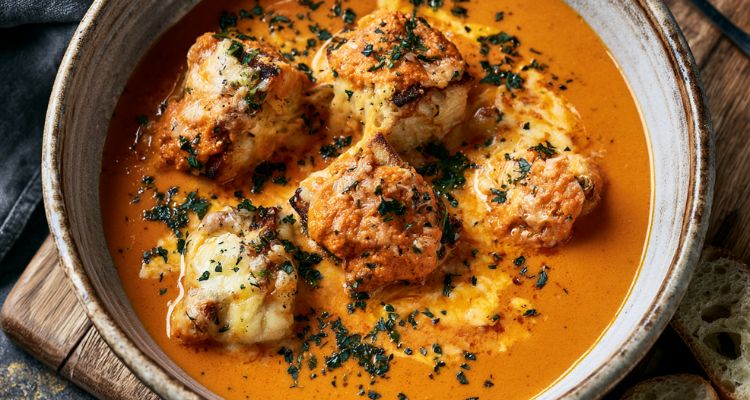

Gordon Ramsay’s fish soup is a classic Provençal soupe de poissons made with a mix of small fish, saffron, fennel, Cognac, and tomatoes, pureed until smooth and served with rouille croutons and melted Gruyère. It takes about an hour from cutting board to table.
This recipe appears as “Soupe de Poissons Provençale” in Gordon Ramsay’s Passion for Flavour, where he describes it as “a fisherman’s soup, so eat it with gusto.” He stresses that “the secret of this soup is to use as many different fish as you can find,” because blending several varieties creates a depth no single fish can match.
The technique that separates this from weaker versions: he fries the fish pieces golden in a separate pan before they go anywhere near the broth. That browning builds a layer of roasted flavour that simmering alone can’t produce, and it’s why the finished soup tastes rich without any cream.
Gordon Ramsay Fish Soup Recipe
Course: SoupsCuisine: BritishDifficulty: Medium4
20
minutes45
340
kcal1
15
minutesA smooth, saffron-scented Provençal fish soup from Gordon Ramsay’s Passion for Flavour, built on a base of mixed fish fried golden then simmered with Cognac, white wine, and tomatoes. Strained twice for a silky texture and served the traditional way: rouille spread on croutons, floated on top, and buried under grated Gruyère.
Ingredients
- Soup
2 lbs (1kg) mixed small fish such as gurnard, red mullet, monkfish, John Dory, sea bream, or snapper, eyes and gills removed, chopped into small pieces with bones left in
1/3 cup plus 1 tbsp (100ml) olive oil
1 medium onion (5 oz / 150g), coarsely chopped
1 whole head of garlic, split in half crossways
3.5 oz (100g) fennel, coarsely chopped
1 tsp saffron strands
1 bouquet garni (thyme, bay leaf, and parsley tied together)
3 tbsp Cognac or brandy
3 tbsp dry white wine
7 oz (200g) ripe tomatoes, roughly chopped
4 1/4 cups (1 litre) cold water
A few stalks of fresh basil
A few stalks of fresh parsley
Sea salt and freshly ground black pepper
- To serve
1 small, thin baguette, sliced very thinly
Oil for frying, or oven toast at 350°F (180°C)
Rouille (garlic and roasted red pepper paste)
5 oz (150g) Gruyère cheese, grated
Directions
- Prepare the fish: Remove and discard the eyes and gills from each fish, because these make the soup taste bitter. Leave the bones in. Chop everything into small pieces.
- Sauté the aromatics: Heat one third of the olive oil in a large saucepan. Add the onion, garlic, fennel, bouquet garni, and saffron and cook until softened.
- Fry the fish: In a separate large frying pan, heat the remaining oil and fry the fish pieces for about 7 minutes until golden all over. Drain through a colander and discard the frying oil.
- Deglaze and reduce: Add the fried fish to the saucepan with the aromatics. Pour in the Cognac and let it reduce. Add the white wine and simmer until the liquid has reduced to about one tablespoon. This double reduction concentrates all the flavour before any water goes in.
- Simmer the soup: Add the tomatoes, cold water, basil stalks, and parsley stalks. Bring to the boil, then lower the heat and simmer for 25 minutes. Skim off any froth with a ladle every 5 minutes.
- Strain and puree: Strain everything through a colander set over a large bowl, reserving the liquid. Discard the garlic halves and bouquet garni. Puree the fish and vegetables in a food processor, thinning with a little of the reserved liquid until smooth.
- Sieve for silk: Push the puree through a fine sieve into a clean saucepan, pressing hard with the back of a ladle. Stir in the rest of the reserved liquid. Season with salt and pepper.
- Make the croutons: Slice the baguette very thinly and either fry in hot oil, turning once until golden and crisp, or spread on a baking sheet and toast at 350°F (180°C) for 15 to 20 minutes.
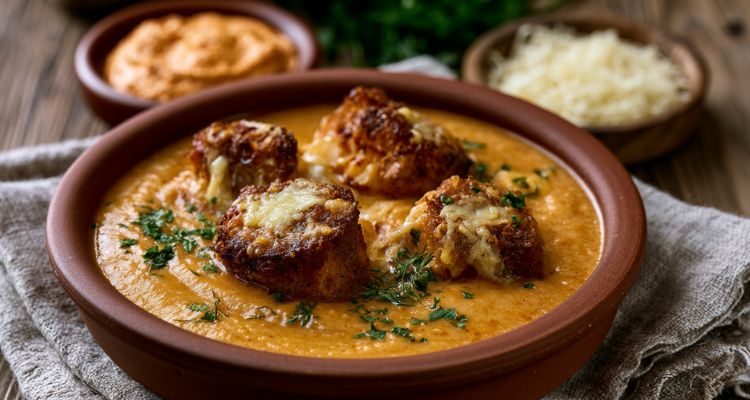
- Serve with rouille: Reheat the soup gently. Spread each crouton with rouille. Ladle the soup into warm bowls, float the croutons on top, and sprinkle generously with grated Gruyère.
FAQs
Why does Ramsay fry the fish separately before adding it to the soup?
Most home fish soup recipes dump raw fish straight into a simmering broth. Ramsay fries his pieces in a separate pan for about 7 minutes until they’re golden all over.
That browning creates roasted, caramelised notes on the surface of the fish through the Maillard reaction. Those flavours dissolve into the broth during the simmer and give the finished soup a depth that raw-simmered fish simply can’t deliver. It’s the same reason you brown meat before making a stew.
Why does he reduce the Cognac and wine down to almost nothing before adding water?
After the fish goes into the aromatics, Ramsay adds Cognac first, lets it reduce, then adds white wine and simmers it down to just one tablespoon of liquid. Only then does the water go in.
This forces all the alcohol to cook off while concentrating the flavour compounds from both the Cognac and wine into a tiny, intense base. If you added the water at the same time, those flavours would be diluted from the start and you’d never get them back. Ramsay’s seafood bisque uses a similar reduction technique with brandy for the same reason.
Why leave the bones in the fish?
Ramsay specifically says to remove only the eyes and gills, keeping everything else intact including the bones. The eyes and gills make soup taste bitter, but the bones do the opposite.
Fish bones release gelatine as they simmer, which gives the soup body and a slightly silky mouthfeel even without cream. Since everything gets pureed and strained through a fine sieve, no bone fragments end up in the finished bowl.
Why does he strain the soup twice?
After pureeing the fish and vegetables, Ramsay pushes the mixture through a fine sieve with the back of a ladle. This is on top of the initial straining through a colander.
The double straining removes every trace of bone, scale, and fibre. What you’re left with is completely smooth, almost like a bisque. A single pass through a colander would leave the soup grainy and rough. That extra five minutes of sieving is the difference between a rustic potage and a refined Provençal classic.
What fish should you use if you can’t find Mediterranean varieties?
Ramsay lists wrasse, rockfish, gurnard, rascasse, conger eel, John Dory, monkfish, and dorade. Most of those are hard to find outside European fish markets. The principle matters more than the exact species: use a mix of at least three different fish.
Red snapper, sea bass, porgy, and monkfish tail are widely available and work well. Avoid oily fish like mackerel or salmon because their strong flavour will overpower the saffron and fennel. Ask your fishmonger for whatever white-fleshed fish scraps or fillets they have going cheap, heads on if possible, and you’ll be close to what Ramsay intends.
What is rouille and can you buy it?
Rouille is a thick, garlicky paste from southern France traditionally made with roasted red peppers, garlic, breadcrumbs or potato, olive oil, and sometimes saffron or cayenne. It’s the classic accompaniment to Provençal fish soups and bouillabaisse.
You can find jarred rouille at specialty stores, but it’s simple enough to make at home by blending roasted red peppers with raw garlic, soaked bread, olive oil, and a pinch of cayenne until smooth. Spread it on the croutons before floating them so it melts into the hot soup. If you enjoy that garlic-forward kick, Ramsay’s lobster bisque pairs well with a similar rouille on the side.

Zaytouna Studio Team is the kitchen team behind Chef Ramsay Recipes. We cook Gordon Ramsay’s recipes from his cookbooks and videos in a home kitchen and write them up for yours, with US and metric measurements.